
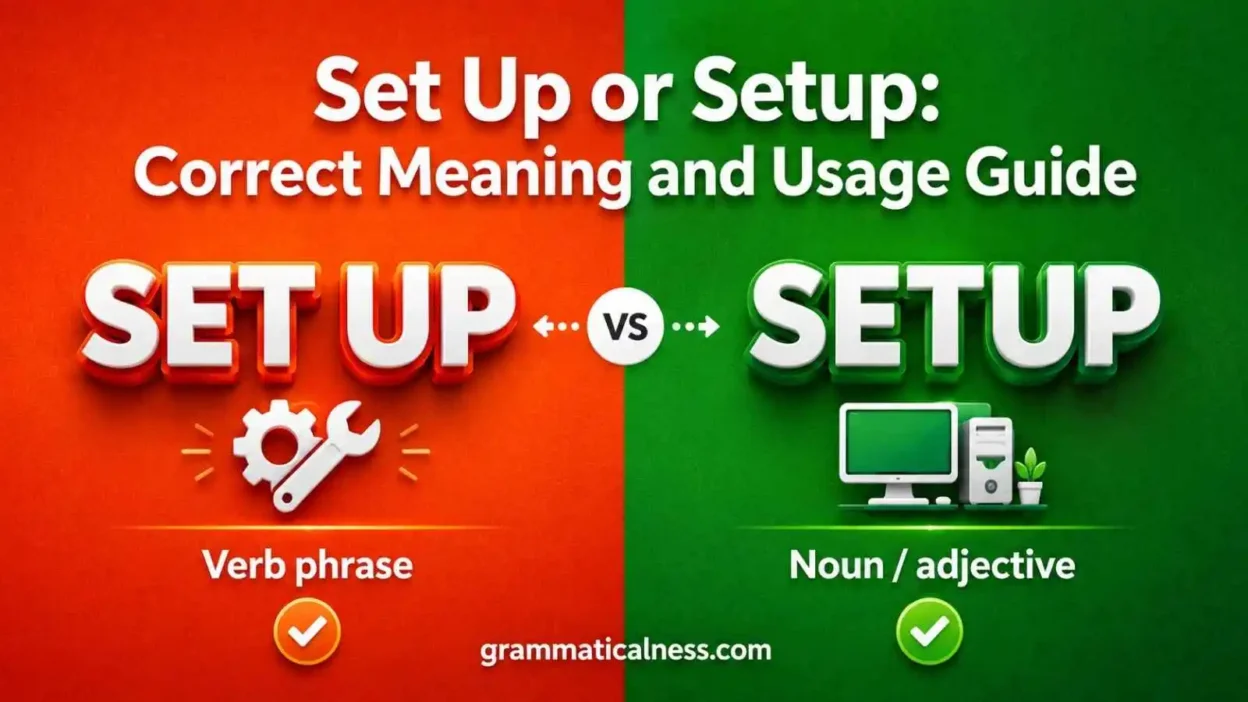
Set up or setup is a common word-choice problem because both forms look almost the same. The correct choice depends on how the words work in the sentence.
Use set up when you mean an action. You can set up a meeting, set up an account, set up a tent, or set up a new phone.
Use setup when you mean a thing, system, arrangement, or description before another noun. You can have a home office setup, a camera setup, a setup fee, or setup instructions.
The easiest question is this: Are you doing the arranging, or are you naming the arrangement? If you are doing it, use set up. If you are naming it, use setup.
Quick Answer
Use set up as a verb phrase. It means to arrange, prepare, create, start, or make something ready.
Correct: I need to set up my new laptop.
Correct: She will set up the meeting for Friday.
Use setup as a noun or adjective. It names an arrangement, system, situation, preparation, or a describing word before another noun.
Correct: This desk setup saves space.
Example: The setup took about ten minutes.
Tip: Read the setup guide before you start.
Do not write “setup an account” when you need a verb. Write “set up an account.” Do not write “a set up fee” when the phrase describes a noun. Write “a setup fee.”
Why People Confuse Them
People confuse set up and setup because the two forms sound nearly the same in speech. The space disappears when we talk, so the difference becomes a writing issue.
The confusion also happens because English often turns verb phrases into single-word nouns. For example, “log in” becomes “login,” and “work out” becomes “workout.” Set up follows a similar pattern: the action stays two words, but the noun or describing form becomes one word.
Another reason is technology. People often see phrases like setup screen, setup file, and setup guide. Then they may copy the one-word form into sentences where they need a verb.
The key is not sound. The key is grammar. Set up does the action. Setup names or describes the result.
Key Differences At A Glance
| Context | Best Choice | Why |
| You are arranging something | set up | It works as a verb phrase |
| You are creating an account | set up | The sentence needs an action |
| You are naming an arrangement | setup | It works as a noun |
| You are describing a guide, screen, fee, or process | setup | It works like an adjective before a noun |
| You mean “ready” after an action | set up | It can appear as a past-participle phrase |
| You mean a planned trick or trap | setup | It names the situation |
Compact comparison:
- set up = action: “Please set up the chairs.”
- setup = thing: “The room setup works well.”
- setup = describing word: “Follow the setup steps.”
- set up can also appear after a form of “be”: “The room is set up.”
Meaning and Usage Difference
Set up means to put something in place, prepare it for use, arrange something, create a system, start a business, or plan an event. It is a verb phrase, so it usually shows action.
Examples:
I’ll set up the projector.
We need to set up direct deposit.
They want to set up a small business.
Setup means the arrangement, system, condition, preparation, or planned situation itself. It can also describe another noun.
Examples:
Your gaming setup looks great.
The setup was simple.
Click the setup button to begin.
Pronunciation does not add much here because the forms sound nearly the same in normal speech. The written difference matters because the grammar is different.
Tone, Context, and Formality
Both set up and setup are standard in American English when used correctly. Neither one is too casual for normal business, school, or technical writing.
Set up fits sentences that describe action. It sounds natural in everyday instructions, emails, workplace writing, and guides.
Examples:
Can you set up the Zoom call?
The team will set up the booth tomorrow.
Setup is common in technology, office writing, gaming, photography, home design, and business costs.
Examples:
The setup fee is due today.
Her camera setup works well for indoor videos.
In American writing, setup is usually the preferred noun and adjective form. The hyphenated form set-up appears in some writing, but it is less common in standard American style unless a specific style guide asks for it.
Which One Should You Use?
Use set up when the sentence needs an action. A quick test is to ask whether you can place a noun or pronoun between set and up.
Correct: I will set up the printer.
Also correct: I will set the printer up.
That test works because set up is a verb phrase.
Use setup when the sentence names something. If you can put the, a, this, or my before it, you probably need the one-word noun.
Correct: The setup was easy.
Correct: My setup needs better lighting.
Use setup before another noun when it describes the type of noun.
Correct: setup guide
Correct: setup fee
Correct: setup screen
When One Choice Sounds Wrong
Setup sounds wrong when the sentence needs an action.
Wrong: I need to setup my account.
Correct: I need to set up my account.
Wrong: Can you setup the chairs?
Correct: Can you set up the chairs?
Set up sounds wrong when the sentence needs a noun or a describing word before a noun.
Wrong: The set up was confusing.
Correct: The setup was confusing.
Wrong: The company charges a set up fee.
Correct: The company charges a setup fee.
There is one important exception in structure, not meaning. After a form of be, set up can describe a completed state.
Correct: The account is set up.
Correct: The room was set up before noon.
Common Mistakes (and Quick Fixes)
Mistake 1: Using setup as a verb.
Wrong: Please setup your password.
Correct: Please set up your password.
Mistake 2: Splitting the noun.
Wrong: The set up took an hour.
Correct: The setup took an hour.
Mistake 3: Splitting the adjective before a noun.
Wrong: Open the set up screen.
Correct: Open the setup screen.
Mistake 4: Changing the past tense incorrectly.
Wrong: I setted up the table.
Correct: I set up the table.
Mistake 5: Missing the state use.
Awkward: The account is setup now.
Better: The account is set up now.
Use this quick fix: action takes two words; thing or description takes one word.
Everyday Examples
Use set up for actions:
I’ll set up the meeting invite.
Can you set up the folding table?
We should set up a shared folder.
They helped us set up the booth.
Please set up your profile before class.
My brother will set up the Wi-Fi tonight.
Use setup for nouns and descriptions:
The setup looks clean and simple.
This home office setup works for small spaces.
The setup fee appears on the first bill.
The app shows a setup screen after installation.
Your camera setup needs better lighting.
The setup guide explains each step.
Use set up for a completed state:
The chairs are set up.
Everything is set up for the party.
Dictionary-Style Word Details
Verb
set up: Commonly used as a verb phrase in standard American English. It means to arrange, prepare, create, start, or make something ready.
Example: We need to set up the classroom before students arrive.
setup: Not commonly used as a verb in standard American English. In normal writing, avoid “to setup.” Use set up instead.
Incorrect: I will setup the device.
Correct: I will set up the device.
Noun
set up: Not normally used as a noun in standard American English. The spaced form belongs mainly to the verb phrase or completed-state structure.
Example: The room is set up.
setup: Commonly used as a noun. It means an arrangement, system, preparation, planned situation, or the way something is organized.
Example: The setup of the room made the meeting feel more relaxed.
Synonyms
set up: Closest plain alternatives include arrange, prepare, organize, start, create, establish, and install, depending on the sentence.
Example: “Set up the printer” can mean “install” or “prepare” the printer.
setup: Closest plain alternatives include arrangement, layout, system, configuration, plan, and preparation, depending on context.
Example: “office setup” can mean “office arrangement” or “office layout.”
Clear antonyms do not fit every use. For set up, possible opposites may include take down, remove, cancel, or dismantle, depending on the sentence. For setup, a single exact opposite is not reliable.
Example Sentences
set up:
Please set up the chairs near the stage.
I need to set up my email account.
They will set up a new branch next year.
The teacher set up a review session before the test.
Everything is set up and ready to go.
setup:
The setup took longer than expected.
His podcast setup includes two microphones.
There is a small setup fee for the service.
Follow the setup guide on the screen.
The new office setup gives everyone more space.
Word History
set up: This is built from the verb set plus up. It has long been used as a verb phrase with meanings connected to placing, preparing, arranging, starting, and creating.
setup: This form developed as a noun from the idea of something being set up. In modern American English, it is usually written as one word when it names an arrangement or describes another noun.
The exact history is not needed for everyday use. For most writers, the practical rule matters more: set up is the action, and setup is the thing or description.
Phrases Containing
set up:
set up a meeting
set up an account
set up the room
set up shop
set up for success
set someone up
set up a camera
set up a business
setup:
home office setup
gaming setup
camera setup
setup fee
setup guide
setup screen
software setup
a complete setup
These phrases show the pattern clearly. If the phrase performs an action, choose set up. If it names or describes something, choose setup.
FAQs
Is it set up or setup?
Use set up when you need a verb. It means to arrange, prepare, create, or make something ready. Use setup when you need a noun or adjective. It means an arrangement, system, process, or preparation.
Correct: I need to set up my account.
Correct: The setup was easy.
Is setup one word or two?
Setup is one word when it works as a noun or adjective. For example, write setup fee, setup guide, setup screen, and home office setup. When you mean the action, write set up as two words.
Is set up a verb?
Yes. Set up is a verb phrase. It means to prepare, arrange, start, create, or put something in place.
Examples:
Please set up the chairs.
She will set up the meeting.
I need to set up my new phone.
Do you write set up a meeting or setup a meeting?
Write set up a meeting. Here, you need a verb because someone is arranging or scheduling the meeting.
Correct: Can you set up a meeting for Monday?
Wrong: Can you setup a meeting for Monday?
What is the easiest way to remember the difference?
Use set up for the action and setup for the thing. If someone is doing something, use two words. If you are naming an arrangement or describing another noun, use one word.
Action: I will set up the room.
Thing: The room setup looks great.
Conclusion
The difference between set up or setup is simple once you look at the job each form does.
Use set up when you mean an action: arrange, prepare, start, create, or make something ready.
Use setup when you mean a noun or a describing word: an arrangement, system, fee, guide, screen, or complete working layout.
We need to set up the room.
The room setup works well.
After the work is done, the room is set up.
When in doubt, use this quick test: If someone is doing the action, write set up. If you are naming the result or describing another noun, write setup.
Use set up when you need a verb. It means to arrange, prepare, create, or make something ready. Use setup when you need a noun or adjective. It means an arrangement, system, process, or preparation.
Correct: I need to set up my account.
Correct: The setup was easy.
Yes. Set up is a verb phrase. It means to prepare, arrange, start, create, or put something in place.
Examples:
Please set up the chairs.
She will set up the meeting.
I need to set up my new phone.
No. In standard American English, setup should not be used as a verb. Do not write “I will setup the printer.” Write “I will set up the printer.”
Write set up a meeting. Here, you need a verb because someone is arranging or scheduling the meeting.
Correct: Can you set up a meeting for Monday?
Wrong: Can you setup a meeting for Monday?
Use set up for the action and setup for the thing. If someone is doing something, use two words. If you are naming an arrangement or describing another noun, use one word.
Action: I will set up the room.
Thing: The room setup looks great.