
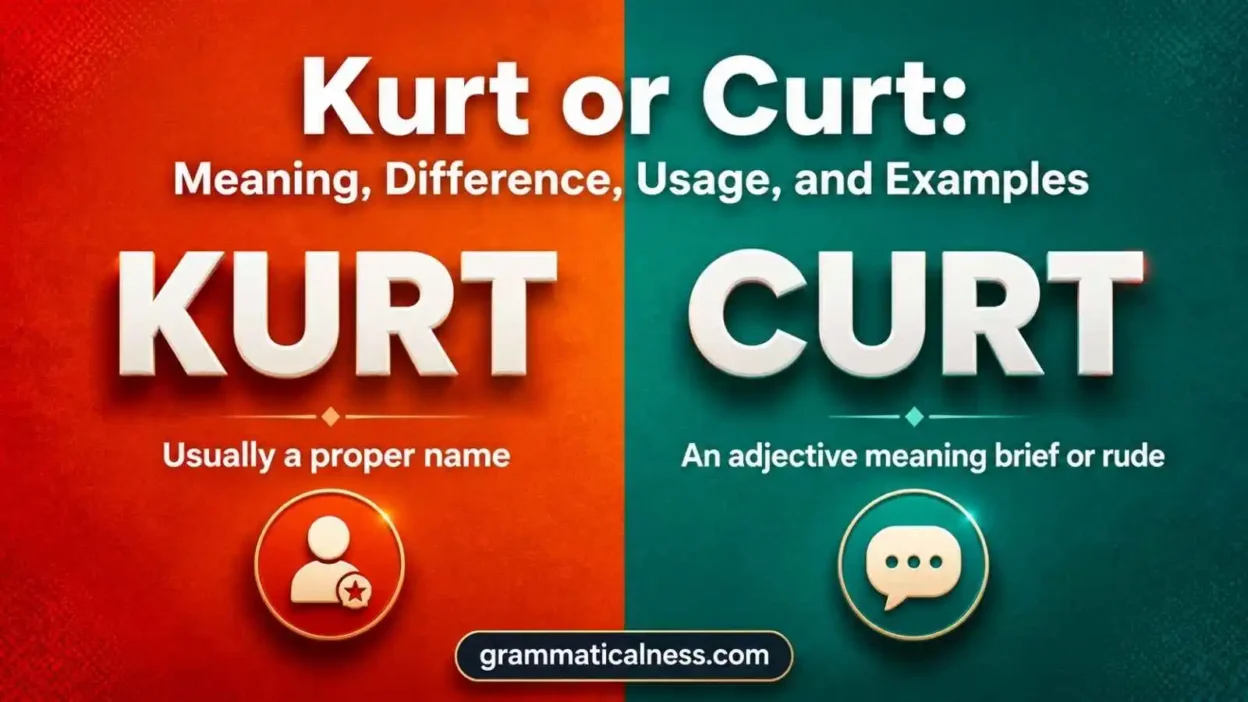
The choice between kurt or curt is simple once you know what each word does. Kurt is mainly a person’s name. Curt is usually an adjective that describes speech, writing, or behavior that is very brief and may sound rude.
The confusion happens because the two words sound the same in standard American English. In writing, though, one letter changes the meaning completely. You would write, “Kurt joined the meeting” if Kurt is a person’s name. You would write, “Her reply was curt” if the reply sounded short, cold, or blunt.
Quick Answer
Use curt when you mean short, blunt, or rudely brief. Use Kurt when you are writing a person’s name spelled that way. The words may sound alike, but they are not interchangeable. A “curt reply” is a brief or unfriendly reply. “Kurt” is a name, not a description of tone.
Why People Confuse Them
People confuse these words because they sound alike. In everyday speech, Kurt and curt are both commonly pronounced like “kert.” That means listeners cannot always tell which spelling is meant unless the sentence gives it away.
Writing is different. The spelling carries the meaning. When you write about a person, you need the correct name spelling. When you describe a short or blunt manner, you need curt.
Another reason for confusion is that Curt can also be a capitalized given name. That does not make lowercase curt the same as Kurt. It only means some people have the name Curt, while curt remains the adjective used in phrases like “a curt answer.”
Key Differences At A Glance
| Context | Best Choice | Why |
| A person named Kurt | Kurt | It is a proper name and should be capitalized. |
| A short, blunt reply | curt | It describes tone or manner. |
| A cold email response | curt | It means brief in a way that may feel rude. |
| A person named Curt | Curt | It is a different proper name spelling. |
| A rude nod or gesture | curt | It describes quick, unfriendly behavior. |
| An official document with someone’s name | The person’s exact spelling | Names should match the official spelling. |
Meaning and Usage Difference
The main difference is meaning. Kurt is used as a proper name. Since names are proper nouns, it should normally be capitalized: “Kurt.” You use it when referring to a person whose name is spelled that way.
Curt is usually an adjective. It describes a way of speaking, writing, or acting that is very short. Often, it also suggests that the shortness feels rude, impatient, or unfriendly. A curt answer is not just brief. It may feel too sharp for the situation.
Compact comparison:
- kurt: not a standard lowercase descriptive word in everyday US English; usually the name Kurt.
- curt: an adjective meaning brief, blunt, or rudely short in manner.
Tone, Context, and Formality
Kurt has no built-in tone when used as a name. The feeling depends on the person or situation, not on the word itself. “Kurt called this morning” is neutral.
Curt often has a negative tone. It suggests that someone used too few words or acted too quickly in a way that felt cold. A manager’s feedback can be curt. A customer service reply can be curt. A text message can seem curt if it is short and lacks warmth.
The word works in both casual and formal writing. It is common in descriptions of tone, behavior, replies, emails, letters, and gestures. In formal writing, curt is useful because it is precise and compact.
Which One Should You Use?
Use Kurt when the word is a name. For example, “Kurt sent the report” is correct if the person’s name is Kurt. In emails, resumes, legal forms, school records, and professional documents, always match the person’s actual spelling.
Use curt when you are describing how something was said or done. For example, “The reply sounded curt” means the reply was too short or blunt. You can also write “a curt tone,” “a curt nod,” “a curt refusal,” or “a curt email.”
A useful memory trick is this: curt contains cut, and a curt answer feels cut short. That is not a full history rule, but it can help you remember the meaning.
When One Choice Sounds Wrong
“Kurt reply” sounds wrong if you mean a brief or rude reply. The correct phrase is “curt reply.” In that sentence, the word describes the reply, so you need the adjective.
“His tone was Kurt” is also wrong unless you are doing something unusual with a name. The natural sentence is “His tone was curt.” The word describes how he sounded.
The reverse mistake also causes problems. “curt joined the call” is wrong if you are naming a person, because names need capitalization. If the person’s name is Kurt, write “Kurt joined the call.” If the person’s name is Curt, write “Curt joined the call.”
Common Mistakes (and Quick Fixes)
One common mistake is using Kurt as an adjective. “She gave a Kurt answer” should be “She gave a curt answer.” The sentence is about the style of the answer, not a person’s name.
Another mistake is using lowercase curt for a person’s name. “curt said hello” should be “Curt said hello” if the person’s name is Curt. If the person spells his name Kurt, then write “Kurt said hello.”
A third mistake is assuming the two spellings are flexible because they sound alike. They are not flexible in careful writing. Sound may explain the confusion, but context decides the spelling.
Everyday Examples
In a workplace message, you might write, “The email was accurate, but the tone sounded curt.” This means the message was short in a way that could feel unfriendly.
In a school setting, a teacher might say, “Try not to sound curt when you disagree.” The teacher is talking about tone, not a name.
In a normal conversation, you might write, “Kurt waited outside while we finished the meeting.” Here, Kurt is a person.
For customer service, you might say, “The response was curt, but it answered my question.” This means the response was useful but not warm.
In a form or official record, you should write the name exactly as the person uses it: “Kurt,” “Curt,” or another spelling.
Dictionary-Style Word Details
Verb
kurt: Not commonly used as a verb in standard US English. When the intended word is the name Kurt, it is a proper noun, not a verb.
curt: Not commonly used as a verb in standard US English. The related adverb is curtly, as in “She answered curtly,” but curt itself is not normally a verb.
Noun
kurt: Lowercase kurt is not a common noun in standard US English. Kurt is mainly a proper noun used as a personal name.
curt: Lowercase curt is not normally a noun when describing tone. Capitalized Curt can be a person’s name, but that is a name use, not the adjective.
Synonyms
kurt: There are no true synonyms for a personal name. Other names are alternatives, not synonyms. If the person’s name is Kurt, do not replace it with another name.
curt: Closest plain alternatives include brief, terse, abrupt, blunt, brusque, and short. These words are not always exact matches. Curt often adds the idea that the shortness may feel rude or unfriendly. Helpful opposites include polite, warm, friendly, and gracious when the focus is tone.
Example Sentences
kurt: “Kurt left a message before lunch.” In this sentence, Kurt is a person’s name.
kurt: “Please ask Kurt whether he approved the final draft.” The spelling depends on the person’s actual name.
curt: “Her reply was curt, so I wondered if she was upset.” Here, curt describes the reply.
curt: “The clerk gave a curt nod and pointed to the next window.” Here, curt describes a quick, unfriendly gesture.
Word History
kurt: Name-history sources commonly connect Kurt with Conrad or Konrad in Germanic name traditions. Details can vary by language and naming source, so the safest everyday point is that Kurt is an established personal name.
curt: The adjective curt is connected with the idea of being shortened or cut short. In modern English, its main everyday use is for speech, writing, or behavior that is brief and often unfriendly.
Phrases Containing
kurt: There are no common fixed English phrases using lowercase kurt. The word appears mainly as the proper name Kurt, as in a person’s full name.
curt: Common phrases include “a curt reply,” “a curt response,” “a curt tone,” “a curt email,” “a curt nod,” and “a curt refusal.” These phrases all describe shortness that may feel cold, impatient, or rude.
FAQs
Is it kurt or curt?
Use curt when you mean short, blunt, or rudely brief. Use Kurt only when writing a person’s name spelled that way. For example, “a curt reply” is correct, but “a Kurt reply” is not.
What does curt mean?
Curt means very brief in a way that may seem rude, cold, or impatient. A curt answer gives little warmth or detail, even if the message is clear.
Is Kurt a real word?
Kurt is mainly used as a person’s name. It is not the correct word for describing a short or rude tone. In regular writing, use curt for that meaning.
Is curt rude?
Curt often suggests rudeness, but not always on purpose. A person may sound curt because they are busy, annoyed, stressed, or trying to be direct. Still, the word usually has a negative tone.
Can Curt also be a name?
Yes. Curt can be a person’s name when capitalized. However, lowercase curt is an adjective meaning brief, blunt, or rudely short.
How do you use curt in a sentence?
You can write: “His reply was curt,” “She gave a curt nod,” or “The email sounded curt.” In each sentence, curt describes tone or behavior.
Are kurt and curt pronounced the same?
In standard American English, Kurt and curt usually sound the same. That is why people confuse them. In writing, the spelling decides the meaning.
What is another word for curt?
Close alternatives include brief, terse, abrupt, blunt, brusque, and short. The best choice depends on how rude or sharp the tone sounds.
What is the opposite of curt?
Good opposites include polite, warm, friendly, gracious, and thoughtful. These words describe speech or behavior that feels more pleasant and respectful.
What is the difference between a curt reply and a short reply?
A short reply is simply brief. A curt reply is brief in a way that may feel rude, cold, or impatient. The word curt adds a stronger tone judgment.
Conclusion
The difference between Kurt and curt is clear. Kurt is a name. Curt is the word you want when describing a short, blunt, or rudely brief manner.
Use the person’s exact spelling for names. Use curt for tone, replies, emails, gestures, and behavior. The words sound alike, but they do different jobs in writing.
Use curt when you mean short, blunt, or rudely brief. Use Kurt only when writing a person’s name spelled that way. For example, “a curt reply” is correct, but “a Kurt reply” is not.
Curt means very brief in a way that may seem rude, cold, or impatient. A curt answer gives little warmth or detail, even if the message is clear.
Kurt is mainly used as a person’s name. It is not the correct word for describing a short or rude tone. In regular writing, use curt for that meaning.
Curt often suggests rudeness, but not always on purpose. A person may sound curt because they are busy, annoyed, stressed, or trying to be direct. Still, the word usually has a negative tone.
Yes. Curt can be a person’s name when capitalized. However, lowercase curt is an adjective meaning brief, blunt, or rudely short.
Yes. Curt can be a person’s name when capitalized. However, lowercase curt is an adjective meaning brief, blunt, or rudely short.
In standard American English, Kurt and curt usually sound the same. That is why people confuse them. In writing, the spelling decides the meaning.
Close alternatives include brief, terse, abrupt, blunt, brusque, and short. The best choice depends on how rude or sharp the tone sounds.
Good opposites include polite, warm, friendly, gracious, and thoughtful. These words describe speech or behavior that feels more pleasant and respectful.
A short reply is simply brief. A curt reply is brief in a way that may feel rude, cold, or impatient. The word curt adds a stronger tone judgment.