
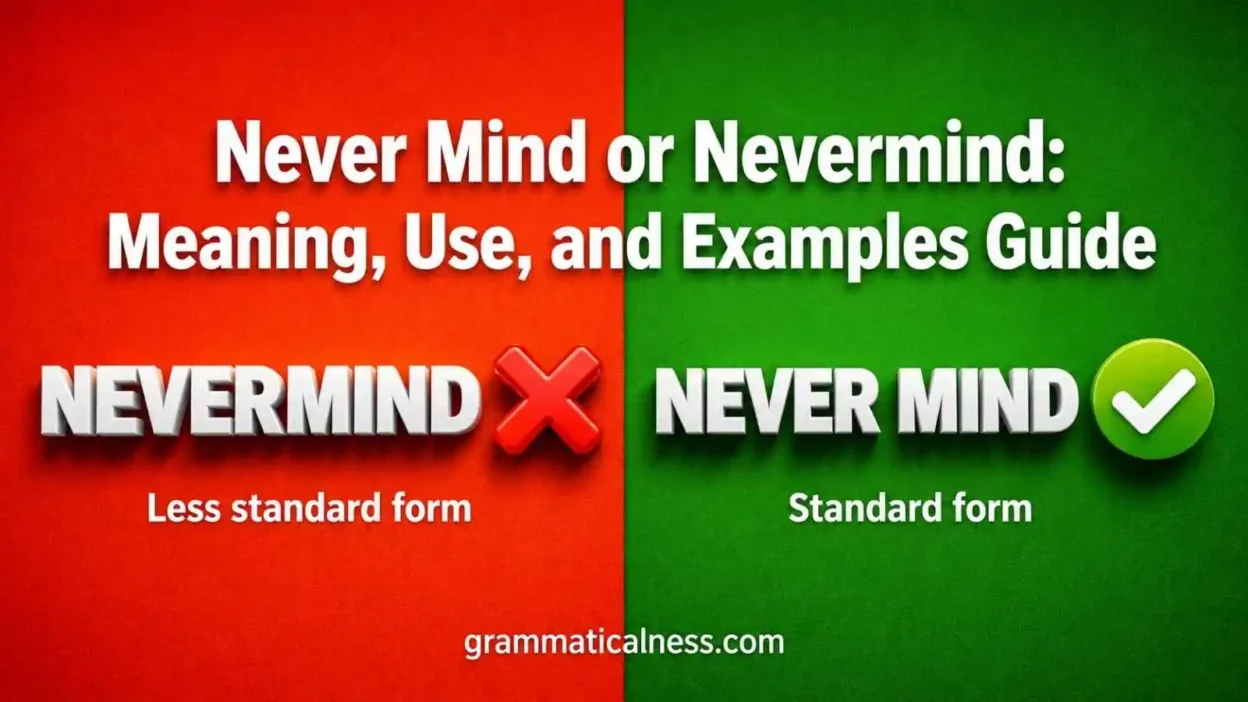
In standard US writing, never mind as two words is almost always the correct choice. Writers use it to mean “forget it,” “don’t worry about it,” “ignore that,” or “let alone.”
By contrast, nevermind is rare and primarily a noun. It appears in expressions such as “pay it no nevermind” or “it’s no nevermind of yours,” usually in regional or informal contexts.
Overall, for emails, articles, messages, or schoolwork, stick with never mind. Reserve nevermind only for those specific noun uses.
Quick Answer
Never mind is your default. Use it like this:
- “Never mind, I found my keys.”
- “I can barely walk a mile, never mind run a 10K.”
Meanwhile, nevermind as a noun works in sentences like:
- “Don’t pay him no nevermind.”
- “That’s no nevermind of yours.”
These examples show the one-word form is informal and far less common.
Why People Confuse Them
The confusion arises mainly from pronunciation—they sound identical when spoken. Pop culture also contributes, since many know Nevermind as an album title or brand.
Additionally, English often turns two-word phrases into single words over time. Despite this pattern, never mind remains the standard for everyday writing, while nevermind has a much narrower, specialized use.
Key Differences At A Glance
| Feature | never mind | nevermind |
| Main role | Phrase or connector | Noun |
| Common meaning | Forget it; don’t worry; let alone | Concern, attention, business, or difference |
| Standard use | Yes, in most writing | Limited and informal |
| Example | “Never mind, I’ll call later.” | “Pay it no nevermind.” |
| Best for | Everyday, school, work, and public writing | Dialect, fiction, dialogue, or a set expression |
Notice that the difference is not just spacing—it’s also function in the sentence.
Meaning and Usage Difference
Never mind has two main functions. First, it can tell someone to disregard a previous statement:
- “Never mind, I figured it out.”
- “Never mind the typo. I’ll fix it before sending.”
Second, it can indicate “let alone” or “not to mention,” often following a negative idea:
- “I can’t afford a used car, never mind a new one.”
- “She barely has time for lunch, never mind a long meeting.”
In contrast, nevermind only works as a noun. You might see it in phrases like “no nevermind” or “pay no nevermind.” It does not replace the standard phrase in everyday writing.
Tone, Context, and Formality
Never mind fits casual, neutral, or polite tones depending on context:
- “Never mind, I’ll handle it” sounds helpful.
- “Never mind, you wouldn’t understand” sounds impatient.
Nevermind carries a narrower tone. It is old-fashioned, regional, or intentionally informal. Writers often use it in dialogue or fiction to reflect character voice:
- “Don’t pay them no nevermind.”
In modern US English, using nevermind where never mind belongs can appear as a mistake.
Which One Should You Use?
| Context | Best Choice | Why |
| “Forget what I just said” | never mind | Standard phrase |
| “Don’t worry about it” | never mind | Everyday writing |
| “Let alone” | never mind | Works as connector |
| Work email | never mind | Professional and correct |
| School assignment | never mind | Teachers expect it |
| Text message | never mind | Clearer than one word |
| Fictional dialogue | nevermind | Fits expressions like “no nevermind” |
| “None of your business” in casual voice | nevermind | Works in colloquial phrases |
| Unsure which to choose | never mind | Safe choice almost always |
When One Choice Sounds Wrong
Using nevermind for everyday dismissal is incorrect:
- Wrong: “Nevermind, I already called her.”
- Correct: “Never mind, I already called her.”
- Wrong: “Nevermind the price for now.”
- Correct: “Never mind the price for now.”
- Wrong: “I can’t finish one page, nevermind the whole report.”
- Correct: “I can’t finish one page, never mind the whole report.”
Conversely, never mind sounds off when a noun form is intended:
- Awkward: “Don’t pay him no never mind.”
- Better: “Don’t pay him no nevermind.”
Even then, that usage is informal. In standard writing, “don’t pay attention to him” would be preferred.
Common Mistakes (and Quick Fixes)
- Mistake: Using nevermind for “forget it.”
Fix: Use never mind — “Never mind, I found the receipt.” - Mistake: Using nevermind for “let alone.”
Fix: Use never mind — “We can’t cover one extra shift, never mind three.” - Mistake: Treating nevermind as default.
Fix: Save it for the noun use — “That’s no nevermind of mine.” - Mistake: Using never mind when professional phrasing fits better.
Fix: Replace with “please disregard” or “ignore my last message.” - Mistake: Assuming the one-word form is always wrong.
Fix: It is valid in rare noun expressions, but not as the standard phrase.
Everyday Examples
Never mind:
- “Never mind, I’ll send the file myself.”
- “I was going to ask for help, but never mind.”
- “Never mind the weather. We can still have lunch inside.”
- “He can’t manage a five-minute call, never mind a full presentation.”
- “Never mind what they said. Focus on what you can control.”
Nevermind (noun, informal):
- “Don’t pay that comment no nevermind.”
- “It makes no nevermind to me if they arrive late.”
- “That’s no nevermind of yours.”
These one-word examples are uncommon and best reserved for dialogue or colloquial voice.
Dictionary-Style Word Details
Verb
- never mind: Not a regular verb. It’s a fixed phrase using “mind” in a command-like context: “Never mind the delay.” Forms like “never-minded” are incorrect.
- nevermind: Not used as a verb in standard US English.
Noun
- never mind: Not a noun in standard US English.
- nevermind: Rarely used as a noun in colloquial expressions: “no nevermind,” “pay no nevermind.”
Synonyms
- never mind: Closest alternatives include “forget it,” “don’t worry about it,” “ignore that,” “let it go,” “let alone,” and “not to mention.”
- nevermind: Closest alternatives include “attention,” “concern,” “business,” “responsibility,” or “difference.”
Example Sentences
- never mind: “Never mind, I found the answer.”
- never mind: “She can’t afford rent downtown, never mind a bigger apartment.”
- never mind: “Never mind the old plan. We have a better option now.”
- nevermind: “Don’t pay him no nevermind.”
- nevermind: “It’s no nevermind to me if they arrive late.”
- nevermind: “That’s no nevermind of yours.”
Word History
- never mind: Developed from “never” + “mind,” meaning disregard or pay no attention. Two-word form remains the standard.
- nevermind: Developed from the phrase as a noun in informal negative expressions. Its use is limited.
Phrases Containing
- never mind: “never mind,” “never mind that,” “never mind about,” “never mind the cost,” “never mind what happened,” “never mind doing that,” “never you mind.”
- nevermind: “no nevermind,” “pay no nevermind,” “make no nevermind,” “no nevermind of yours.”
FAQs
Yes, but only as a noun in informal or regional expressions, e.g., “Don’t pay him no nevermind.” For almost all other uses, never mind is correct.
No. Professional emails, reports, and academic work should always use never mind. The one-word form looks informal or incorrect in standard writing.
It has two main uses:
Disregard something: “Never mind, I’ll handle it.”
Let alone / not to mention: “I can’t finish one page, never mind the whole report.”
It is two words in almost all standard contexts. Nevermind as one word is mainly a noun and uncommon.
Not in standard US English. If you need a noun, you may sometimes see nevermind in old-fashioned or informal expressions.
Yes. “NVM” is a text/online abbreviation for “never mind,” but it is not appropriate in formal writing.
Often, yes. “Forget it” can replace “never mind” in casual contexts, but “never mind” is more versatile, especially for “let alone” constructions.
Only in rare cases for dialogue or stylistic effect. For ordinary sentences, always use never mind.
Conclusion
For almost every sentence, never mind is correct. Reserve nevermind for the rare noun use in informal, regional, or character-driven contexts.
When in doubt, never mind is the safe and standard US-English choice.