
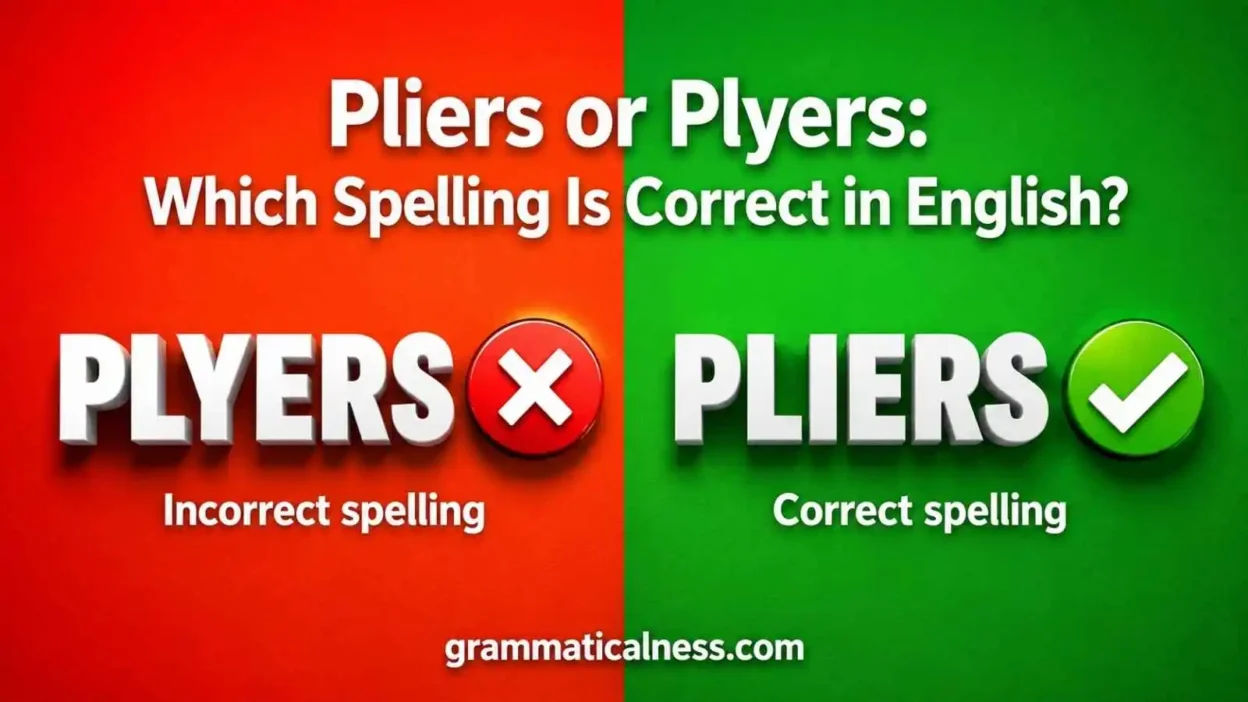
The correct choice is pliers.
Use pliers when you mean the hand tool people use to grip, bend, twist, pull, or cut small objects. Although plyers may look possible, it does not work as the normal spelling in modern US English.
Most readers expect pliers in everyday writing. Therefore, choose it for emails, product descriptions, repair guides, tool labels, school work, and professional instructions.
Quick Answer
Pliers is the correct modern spelling.
By contrast, plyers looks like a spelling mistake to most US readers today. Some references may mention it as a rare variant, but that does not make it the best choice for normal writing.
Correct: I need a pair of pliers to loosen the wire.
Wrong in modern standard use: I need a pair of plyers to loosen the wire.
In short, write pliers when you mean the tool.
Why People Confuse Them
Many people confuse pliers and plyers because the two forms sound alike.
Also, plyers looks believable because English has words such as ply, plying, and plyer. As a result, some writers assume the tool name should keep the y.
However, the standard tool name uses ie: pliers. Since the word also looks plural, it can confuse readers even more. One tool can still be called pliers, especially in the phrase a pair of pliers.
Confused between “pliers or plyers”? Don’t stop there—learn the correct usage of “fliers or flyers” to sharpen your spelling accuracy and avoid common writing mistakes.
Key Differences At A Glance
| Context | Best Choice | Why |
|---|---|---|
| Standard US English | pliers | Readers recognize this as the correct spelling. |
| Tool labels | pliers | It matches normal tool and product wording. |
| Repair instructions | pliers | It keeps directions clear and professional. |
| School writing | pliers | It follows standard modern usage. |
| Talking about the spelling mistake | plyers | Use it only when naming the error. |
| Older or variant references | plyers | Some references may mention it, but modern writing favors pliers. |
Meaning and Usage Difference
Pliers names a hand tool with two handles and gripping jaws. People use pliers to hold, bend, twist, pull, or cut items such as wire, nails, small parts, and jewelry pieces.
Plyers usually points to the same tool when people write it. However, modern US English does not treat it as the normal spelling.
Therefore, the main difference is not meaning. The main difference is standard usage.
Choose pliers for the tool. Use plyers only when you discuss the spelling itself.
Pronunciation also explains the confusion. Pliers sounds like PLY-erz, and plyers would sound the same. Because the words sound alike, the wrong spelling can feel natural.
Tone, Context, and Formality
Pliers works in every normal setting. You can use it in casual notes, workplace messages, product pages, manuals, school assignments, and professional documents.
In contrast, plyers does not create a special tone. It does not sound more casual, more technical, or more formal. Instead, it usually makes the sentence look less polished.
For example, a product listing that says needle-nose plyers may still make sense. However, needle-nose pliers looks clearer, cleaner, and more professional.
Which One Should You Use?
Use pliers almost every time.
Write:
I packed a screwdriver, a wrench, and a pair of pliers.
The electrician grabbed pliers to bend the wire.
Keep the pliers in the garage drawer.
Only choose plyers when your sentence talks about the spelling mistake.
Example: Many people type plyers when they mean pliers.
That simple rule keeps your writing clear, correct, and easy to trust.
When One Choice Sounds Wrong
Plyers sounds wrong in normal tool-related writing because it distracts the reader.
Wrong: Use plyers to pull out the staple.
Better: Use pliers to pull out the staple.
Wrong: These plyers work well for electrical repairs.
Better: These pliers work well for electrical repairs.
Also, watch the singular form. Since pliers looks plural, some writers struggle with the phrase.
Natural: I bought a pair of pliers.
Also common: I bought some pliers.
Less natural in careful writing: I bought a pliers.
Common Mistakes (and Quick Fixes)
Mistake 1: Writing plyers for the tool.
Fix: Write pliers.
Mistake 2: Thinking pliers must be wrong because it uses ie.
Fix: Remember that pliers is the standard spelling.
Mistake 3: Writing a pliers in careful writing.
Fix: Write a pair of pliers instead.
Mistake 4: Adding plyers to a product name or repair guide.
Fix: Use pliers so the wording looks professional.
Mistake 5: Treating plyers as a different tool.
Fix: Give the tool only one standard modern spelling: pliers.
Everyday Examples
I keep a pair of pliers in the kitchen drawer.
Can you hand me the pliers from the toolbox?
These needle-nose pliers work well for small wires.
The mechanic grabbed pliers to pull the clip loose.
You typed plyers, but the standard spelling is pliers.
For this repair, you need gloves, tape, and a pair of pliers.
My dad keeps the pliers on the shelf next to the hammer.
Please do not use rusty pliers on clean jewelry wire.
Dictionary-Style Word Details
| Feature | Pliers | Plyers |
|---|---|---|
| Standard status | Correct modern spelling | Rare variant or common misspelling |
| Main meaning | A gripping, bending, twisting, pulling, or cutting hand tool | Usually points to the same tool |
| Best use | Everyday and professional writing | Discussing the spelling mistake |
| Reader reaction | Clear and expected | Often looks incorrect |
Verb
Writers do not commonly use pliers as a verb in standard US English. The word normally works as a noun.
Similarly, writers do not commonly use plyers as a verb. In most cases, it appears as a spelling issue rather than a real verb form.
Noun
As a noun, pliers means a hand tool with handles and gripping jaws. It can name one tool, especially in the phrase a pair of pliers.
Meanwhile, plyers can appear as a rare variant. Even so, modern US English strongly favors pliers as the noun form.
Synonyms
Closest plain alternatives for pliers include pincers, tongs, and gripping tool. However, these words do not fit every situation. Pliers remains the clearest word for the common hand tool.
For plyers, a separate synonym list would not help because the spelling points to the same idea. Instead, replace plyers with pliers.
Clear antonyms do not fit either word. After all, a tool name like pliers does not have a true opposite in everyday use.
Example Sentences
Use pliers to bend the wire into a small hook.
A pair of pliers can help remove the bent nail.
The plumber reached for adjustable pliers.
Change plyers to pliers in standard writing.
The spelling plyers may confuse readers.
Word History
The word pliers connects with ply in the sense of bending or working something. That connection fits the tool’s job because pliers help people bend, grip, twist, and shape materials.
Some references mention plyers as a variant or older form. Still, modern standard writing strongly favors pliers.
Phrases Containing
Common phrases with pliers include a pair of pliers, needle-nose pliers, locking pliers, cutting pliers, lineman’s pliers, and slip-joint pliers.
Modern standard US English does not commonly use plyers in tool phrases. Therefore, write pliers in product names, instructions, labels, and everyday sentences.
FAQs
Is it pliers or plyers?
Pliers is the correct modern spelling. Plyers may appear as a rare variant, but most readers will see it as a spelling mistake.
Is plyers ever correct?
Some references may mention plyers as a variant or older spelling. However, you should use pliers in everyday US English.
Why is pliers spelled with “ie”?
English spelling does not always follow sound alone. Although the word sounds like it could use y, the standard tool name uses ie: pliers.
Is pliers singular or plural?
Pliers has a plural form, but it can refer to one tool. For one tool, a pair of pliers sounds natural and correct.
Can I say “a pliers”?
In careful writing, avoid a pliers. Instead, write a pair of pliers.
What does pliers mean?
Pliers means a hand tool people use for gripping, holding, bending, twisting, pulling, or cutting small objects.
Is plyers a different tool?
No. Plyers does not name a separate tool in modern standard English. Usually, it appears as a nonstandard spelling of pliers.
Which spelling should I use in product descriptions?
Use pliers in product descriptions, labels, manuals, and listings. This spelling looks clear, standard, and professional.
Conclusion
For modern US English, pliers is the right choice.
Plyers may appear as a rare variant or older spelling, but it does not fit normal everyday writing. Therefore, choose pliers when you mean the tool.
Here is the simple rule: write pliers for the hand tool, and use plyers only when you explain the spelling mistake.