
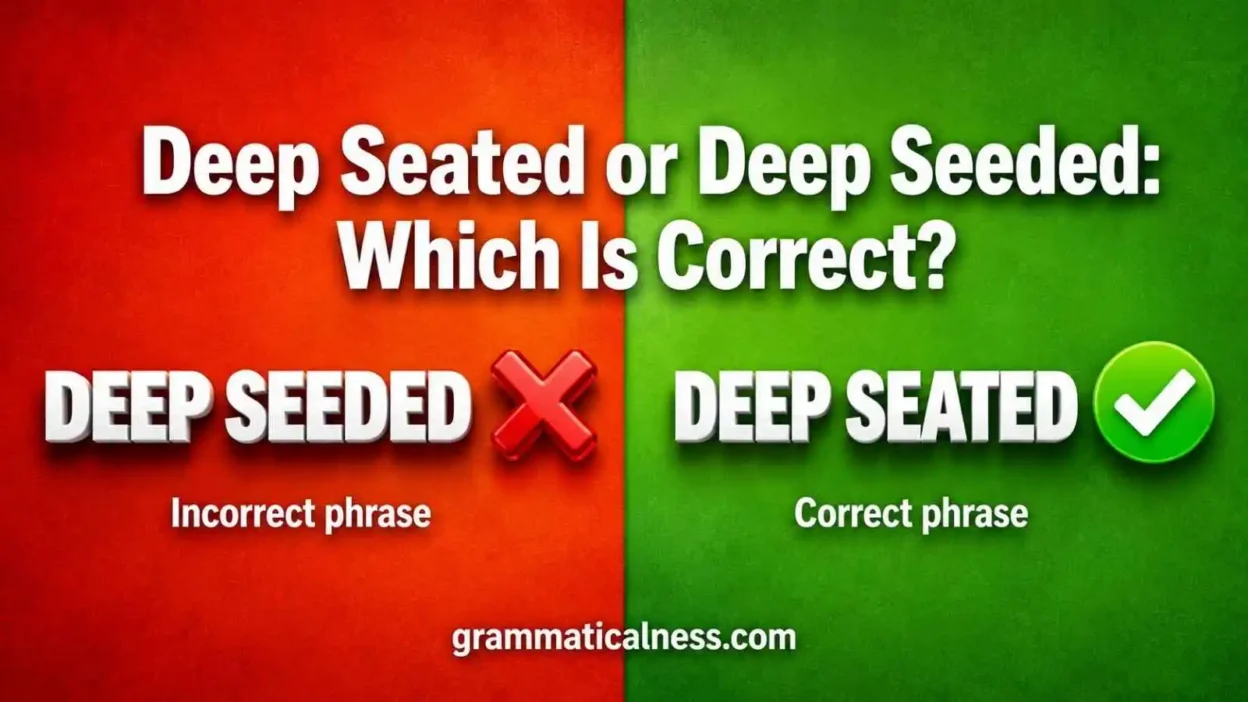
If you are choosing between deep seated or deep seeded, use deep-seated in standard writing.
Writers sometimes type the phrase without the hyphen. However, polished writing usually uses deep-seated when the phrase comes before a noun.
This phrase describes something firmly established, strongly held, or hard to change. For example, someone may have a deep-seated fear, a company may face deep-seated problems, or a family may carry deep-seated resentment.
By contrast, deep seeded usually appears as a mistake when someone means a belief, feeling, habit, or issue that has lasted a long time.
Quick Answer
Correct: deep-seated
Usually wrong: deep seeded
Use these forms:
- a deep-seated fear
- a deep-seated belief
- long-standing, deep-seated problems
- years of deep-seated resentment
Avoid these forms:
- a deep seeded fear
- several deep seeded beliefs
- serious deep seeded problems
A simple memory tip helps: something deep-seated sits firmly in place. It does not grow from a seed.
Why People Confuse Them
Many people confuse these phrases because seated and seeded sound almost the same.
In addition, the wrong version can feel logical. A writer may picture an idea or fear as something “planted” deep inside a person. Although that image makes sense, it does not match the accepted phrase.
Instead, deep-seated points to something settled, fixed, or firmly placed. Therefore, it works well for long-held emotions, beliefs, habits, and problems.
Key Differences At A Glance
| Feature | deep seated | deep seeded |
| Standard written form | Usually written as deep-seated | Avoid for this meaning |
| Meaning | Firmly established or hard to change | Common mistaken form |
| Best use | Fears, beliefs, habits, problems | Not for the usual phrase |
| Tone | Natural in serious and everyday writing | Looks incorrect in edited writing |
| Hyphen | Writers usually add a hyphen before a noun | Hyphenation does not make it correct |
The main point is simple: deep seated points to the correct phrase, but the best written form is deep-seated.
Meaning and Usage Difference
Deep-seated means firmly established, deeply held, or difficult to remove.
Writers often use it for things inside a person, group, or system, such as:
- deep-seated fear
- deep-seated anger
- deep-seated mistrust
- deep-seated beliefs
- deep-seated workplace issues
- deep-seated cultural habits
On the other hand, deep seeded does not serve as the standard way to express that idea. It may sound as if it means “planted deeply,” yet careful writers do not use it for long-held feelings or problems.
When you are talking about actual seeds, choose clearer wording:
- The gardener planted the seeds deep in the soil.
- Before the rain arrived, the crew seeded the field carefully.
In most word-choice situations, though, deep-seated is the right choice.
👉 Deep-seated English mistakes often appear in similar confusing word pairs—like the difference between unfazed and “unphased,” which we explain clearly in this guide.
Tone, Context, and Formality
Deep-seated sounds serious, clear, and natural. It fits school papers, work emails, reports, articles, and everyday explanations.
The phrase also feels stronger than words like old, strong, or serious. A deep-seated issue is not a small problem. Likewise, a deep-seated fear is not a quick worry that disappears in a day.
Meanwhile, deep seeded can distract readers. In casual speech, people may not notice the difference because the two phrases sound so similar. In writing, however, the error stands out.
For that reason, choose deep-seated whenever the sentence describes something lasting, serious, or hard to change.
Which One Should You Use?
Use deep-seated when you mean something firmly established or difficult to change.
| Context | Best Choice | Why |
| A fear that has lasted for years | deep-seated | It means strongly held and hard to remove. |
| A company problem that keeps returning | deep-seated | It suggests the cause sits deep in the system. |
| A belief shaped by childhood | deep-seated | It shows the belief feels deeply held. |
| Seeds placed far below the soil | planted deep | This sounds clearer than deep seeded. |
| A formal essay or report | deep-seated | It matches standard written usage. |
| A casual text about a strong feeling | deep-seated | It remains the correct choice. |
As a quick test, replace the phrase with firmly established. If that meaning fits, deep-seated fits too.
When One Choice Sounds Wrong
Deep seeded sounds wrong when it describes emotions, opinions, habits, social issues, or personal fears.
Wrong: She has a deep seeded fear of driving.
Better: She has a deep-seated fear of driving.
Wrong: The team has deep seeded trust issues.
Better: The team has deep-seated trust issues.
Wrong: The policy caused deep seeded resentment.
Better: The policy caused deep-seated resentment.
The word seeded belongs more naturally in other contexts, such as planting, sports brackets, seeded bread, or fruit with seeds. Therefore, it does not work in this common phrase.
Common Mistakes (and Quick Fixes)
Mistake 1: Writing “deep seeded” because it sounds natural
Fix: Use deep-seated for feelings, beliefs, habits, and problems.
Mistake 2: Leaving out the hyphen before a noun
Fix: Write a deep-seated issue, not a deep seated issue, in polished writing.
Mistake 3: Using the phrase for something small or temporary
Fix: Save deep-seated for something serious, lasting, or hard to change.
Mistake 4: Choosing “seeded” because it sounds more visual
Fix: Keep the clear, accepted phrase: deep-seated.
Everyday Examples
Here are natural examples with the correct phrase:
- Her deep-seated fear of rejection made dating stressful.
- The city still faces deep-seated housing problems.
- His deep-seated loyalty to his hometown shaped his choices.
- During the argument, the family revealed deep-seated tension.
- Years of poor communication created deep-seated mistrust.
- The new manager wanted to fix several deep-seated habits.
Now compare those with forms to avoid:
- Avoid: Her deep seeded fear of rejection made dating stressful.
- Avoid: The city still faces deep seeded housing problems.
- Avoid: The argument revealed deep seeded tension in the family.
For a smoother sentence, you can also write:
“Maria wanted a quick fix, but the problem ran deeper than she first thought.”
Another natural option is:
“Maria wanted a quick fix, but the problem was deep-seated.”
Dictionary-Style Word Details
Verb
deep seated: This phrase does not commonly work as a verb in standard American English. Instead, writers use deep-seated as an adjective.
deep seeded: This phrase also does not work as a verb for this meaning. However, seeded can appear as a verb form in other contexts, such as “The landscaper seeded the lawn.”
Noun
deep seated: This phrase does not commonly work as a noun. It describes a noun, as in deep-seated fear or deep-seated problem.
deep seeded: This phrase does not commonly work as a noun either. In this comparison, it usually appears as a mistaken version of deep-seated.
Synonyms
deep seated: Closest plain alternatives include deep-rooted, ingrained, entrenched, firmly established, and long-standing.
Depending on the sentence, possible opposites include surface-level, temporary, minor, or easy to change.
deep seeded: No true synonyms fit this mistaken phrase in the same meaning. If you mean “firmly established,” use deep-seated or one of its close alternatives.
Example Sentences
deep seated:
- The lawsuit exposed deep-seated problems in the company.
- He carried a deep-seated fear of failure into every job interview.
- By the end of the season, the coach noticed deep-seated frustration among the players.
deep seeded:
- Avoid this form when you mean deep-seated.
- Instead of “deep seeded anger,” write deep-seated anger.
- For “deep seeded beliefs,” use deep-seated beliefs instead.
Word History
deep seated: The phrase combines deep with seated, which gives the sense of something fixed or settled deeply. Today, the phrase means firmly established or difficult to change.
deep seeded: This form likely spreads because seeded sounds like seated. In addition, the seed image feels tempting. Even so, it does not match the standard phrase for lasting emotions, beliefs, or problems.
Phrases Containing
deep seated:
- deep-seated fear
- deep-seated anger
- deep-seated resentment
- deep-seated belief
- deep-seated mistrust
- deep-seated problem
- deep-seated need
- deep-seated habit
deep seeded:
- Do not use this form for the usual meaning.
- Replace deep seeded fear with deep-seated fear.
- Change deep seeded problem to deep-seated problem.
- Use deep-seated belief instead of deep seeded belief.
FAQs
Is “deep seated” or “deep seeded” correct?
Deep-seated is correct in standard writing. Although people often search for deep seated, the polished form usually takes a hyphen before a noun.
What does “deep-seated” mean?
Deep-seated means firmly established, deeply held, or difficult to change. For example, a person can have a deep-seated fear, and a company can have deep-seated problems.
Why do people write “deep seeded”?
People write deep seeded because seeded sounds like seated. Also, the idea of something planted deep inside a person can seem logical. Even so, deep-seated remains the accepted phrase.
Should “deep-seated” have a hyphen?
Yes, use the hyphen when the phrase comes before a noun.
Correct: a deep-seated fear
Less polished: a deep seated fear
Can “deep seeded” ever be right?
It can make sense only in a literal seed-related sentence. Even then, clearer wording usually works better.
For example, write The farmer planted the seeds deep in the soil instead of forcing deep seeded into the sentence.
Is “deep-rooted” the same as “deep-seated”?
Deep-rooted and deep-seated are close in meaning. Both can describe something firmly established. However, when you are choosing between deep seated or deep seeded, the correct choice is deep-seated.
What is an example of “deep-seated”?
A clear example is: She has a deep-seated fear of failure.
This means her fear is strong, long-lasting, and hard to change.
What is a better word than “deep-seated”?
Good alternatives include deep-rooted, ingrained, entrenched, firmly established, and long-standing. However, the best choice depends on your sentence.
Conclusion
Use deep-seated, not deep seeded, when you describe something firmly established, strongly held, or hard to change.
The phrase deep seated or deep seeded causes confusion because the words sound alike. Still, the standard choice is clear: write deep-seated, especially before a noun.
Choose deep-seated for fears, beliefs, habits, tensions, resentment, and serious problems. If you mean actual seeds, use clearer wording such as planted deep or seeded carefully.