
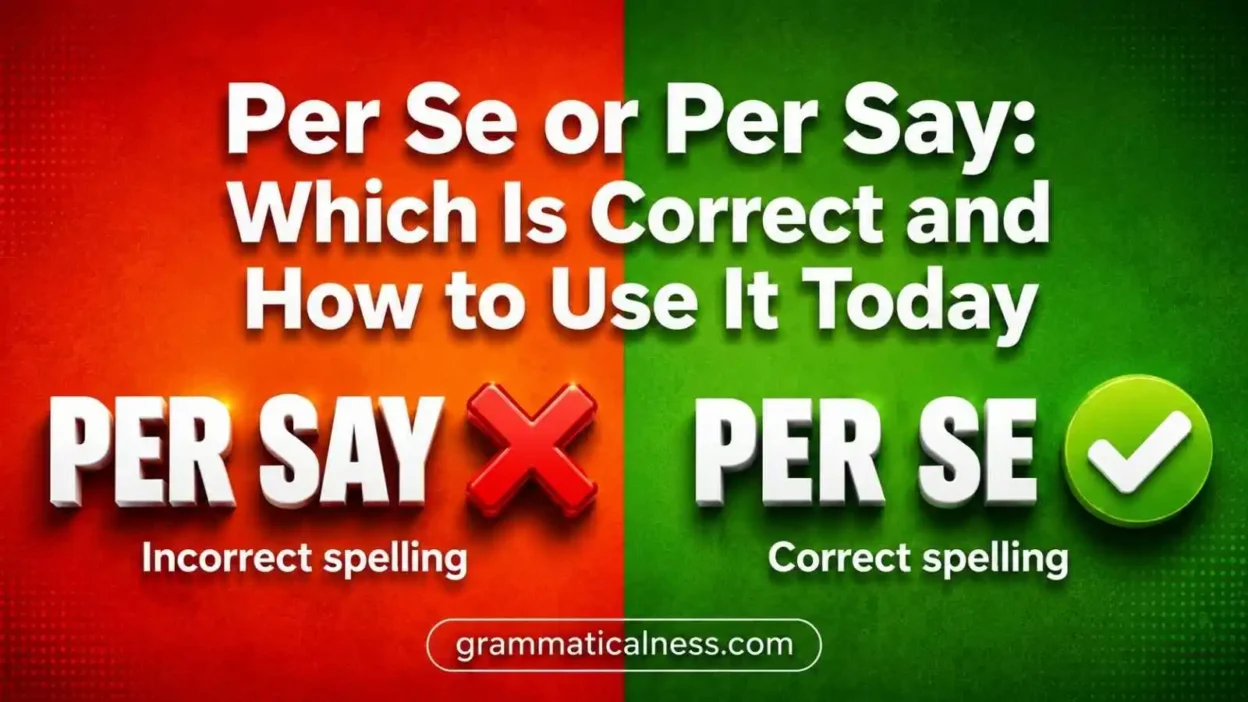
Per se is correct. Per say is not the standard phrase.
Use per se when you mean “by itself,” “in itself,” or “considered on its own.” For example: “The idea is not bad per se, but the timing is off.”
Per say usually happens because people spell the phrase the way it sounds. In speech, se is often pronounced like “say,” so the mistake is easy to understand. In writing, though, the accepted form is per se.
Quick Answer
Choose per se.
Correct: The price is not the issue per se; the hidden fees are.
Incorrect: The price is not the issue per say; the hidden fees are.
Per se is a Latin expression used in English. It helps you separate one thing from the larger situation around it. Per say does not carry that meaning in standard US English.
Why People Confuse Them
The confusion is mostly about sound.
Many Americans pronounce per se like “per SAY.” Because say is a familiar English word, writers sometimes replace se with say by mistake.
That does not make per say an informal version. It is not a casual spelling, and it is not a separate phrase with a different meaning. When you mean “in itself,” write per se.
Key Differences At A Glance
- per se: the correct phrase; means “by itself” or “in itself.”
- per say: a common error when the writer means per se.
- per se: works in casual, professional, academic, and legal writing.
- per say: should be corrected in standard writing.
- per se: often softens or limits a statement.
- per say: does not add the intended meaning.
Meaning and Usage Difference
Per se means that something is being considered alone, apart from related details.
When you say, “The job is not stressful per se,” you mean the job itself is not stressful. Something around it may be stressful, such as the commute, schedule, manager, or workload.
That is the main use of per se: it narrows the point.
Per say does not work this way. The word say is a real English verb, but per say is not the standard expression for “in itself.”
Pronunciation matters here because per se is commonly said like “per SAY.” Some dictionaries also recognize a “per SEE” pronunciation, but the common writing mistake comes from hearing “per SAY.”
Tone, Context, and Formality
Per se sounds a little polished, but it is not limited to legal or academic writing. You can use it in everyday US English when it helps make your meaning precise.
It fits well in:
- work emails
- essays
- reviews
- reports
- news-style writing
- careful conversation
Still, do not overuse it. In very plain writing, by itself, on its own, or in itself may sound more natural.
Per say sounds wrong in edited writing because readers who know the phrase will see it as a mistake.
Which One Should You Use?
| Context | Best Choice | Why |
| Email to a manager | per se | It sounds clear and professional. |
| School essay | per se | It is the accepted phrase. |
| Legal or policy writing | per se | It has standard formal use. |
| Text to a friend | per se or a plain alternative | “By itself” may sound more natural. |
| Any edited writing | per se | “Per say” should be corrected. |
| When unsure | by itself | A simple replacement avoids confusion. |
When One Choice Sounds Wrong
Per say sounds wrong when it replaces per se.
Wrong: I do not dislike the app per say.
Right: I do not dislike the app per se.
Plain: I do not dislike the app itself.
There is one narrow point to know: per and say can appear near each other in a different sentence structure, usually with commas.
Example: We could charge per, say, household.
That does not mean per say is correct as a phrase. In that sentence, say means “for example,” and the commas show that it is separate.
Common Mistakes (and Quick Fixes)
Mistake: Writing per say because it sounds right.
Fix: Write per se.
Mistake: Using per se to mean “necessarily.”
Fix: Use necessarily when that is what you mean.
Weak: It is not per se expensive.
Better: It is not necessarily expensive.
Mistake: Adding per se when it does not help.
Fix: Cut it or use plain English.
Wordy: The meeting was not productive per se.
Clearer: The meeting was not productive.
Mistake: Thinking per se always makes writing stronger.
Fix: Use it only when you are separating the thing itself from the wider situation.
Everyday Examples
The movie was not boring per se, but it was too long.
I do not hate group projects per se; I just dislike unclear roles.
The apartment is not expensive per se, but parking costs extra.
The rule is not unfair per se, but it is hard to apply.
She is not shy per se; she just needs time to warm up.
The meal was not unhealthy per se, but the portion was huge.
The plan is not risky per se, but we need a backup.
That comment was not rude per se, but the timing made it awkward.
Dictionary-Style Word Details
Verb
- per se: Not commonly used as a verb in standard US English. It works mainly as an adverbial phrase, as in “The fee is not the problem per se.”
- per say: Not commonly used as a verb phrase meaning per se. The word say can be a verb by itself, but per say is not the correct phrase for “by itself.”
Noun
- per se: Not commonly used as a noun in standard US English. In ordinary writing, it functions mainly as an adverbial phrase. It can also appear before nouns in formal or legal-style phrases, such as “per se rule.”
- per say: Not a standard noun phrase with the meaning of per se.
Synonyms
- per se: Closest plain alternatives include by itself, in itself, on its own, as such, intrinsically, and inherently. Choose the one that fits the sentence.
- per say: No true synonyms apply because it is not the accepted phrase. If you meant per se, use one of the alternatives above.
Clear opposites are not exact, but the closest contrast is something like in context, because of outside factors, or in relation to something else.
Example Sentences
- per se: The software is not confusing per se, but the setup screen needs work.
- per se: I do not dislike the neighborhood per se; I just need a shorter commute.
- per se: The policy is not harmful per se, but it may affect small teams unevenly.
- per say: The phrase is not standard when you mean “in itself.” Write per se instead.
Word History
- per se: Comes from Latin and is commonly explained as meaning “by itself” or “in itself.” In modern English, it keeps that basic idea: looking at something on its own.
- per say: Has no separate standard word history as an English phrase meaning “by itself.” It is best understood as a sound-based error for per se.
Phrases Containing
- per se: Common patterns include not bad per se, not illegal per se, not the issue per se, per se rule, and negligence per se.
- per say: No standard phrases contain per say with the intended meaning of per se. When you see it used that way, correct it to per se.
FAQs
Is it “per se” or “per say”?
The correct phrase is per se. Use it when you mean “by itself,” “in itself,” or “on its own.” Per say is a common spelling mistake.
Is “per say” ever correct?
Not when you mean per se. Per say is not the standard phrase. The only time per and say may appear near each other is in a different sentence structure, such as “per, say, household,” where say means “for example.”
What does “per se” mean?
Per se means “by itself” or “considered on its own.” It helps separate one thing from the larger situation around it.
Example:
The job is not stressful per se, but the long hours are hard.
Why do people write “per say”?
People write per say because per se is often pronounced like “per SAY.” The sound leads some writers to spell it with the familiar English word say.
Is “per se” formal?
Per se sounds a little formal or polished, but it is common in standard US English. It works in essays, emails, reports, reviews, and careful conversation.
What can I use instead of “per se”?
Good plain alternatives include by itself, in itself, on its own, and as such. Choose the one that sounds most natural in your sentence.
Can I use “per se” in casual writing?
Yes, but use it lightly. In casual writing, by itself or on its own may sound more natural.
Casual: The movie was not bad by itself.
Slightly polished: The movie was not bad per se.
Is “per se” one word or two?
Per se is two words. Do not write it as perse, per-se, or per say.
Conclusion
The correct choice is per se, not per say.
Use per se when you mean “by itself,” “in itself,” or “considered on its own.” It helps you explain that the thing itself is not the main issue, even if the wider situation is.
Per say is a common mistake caused by pronunciation. It may sound like the correct phrase, but it is not the accepted spelling or usage.
When in doubt, write per se or choose a plain alternative like by itself or on its own.