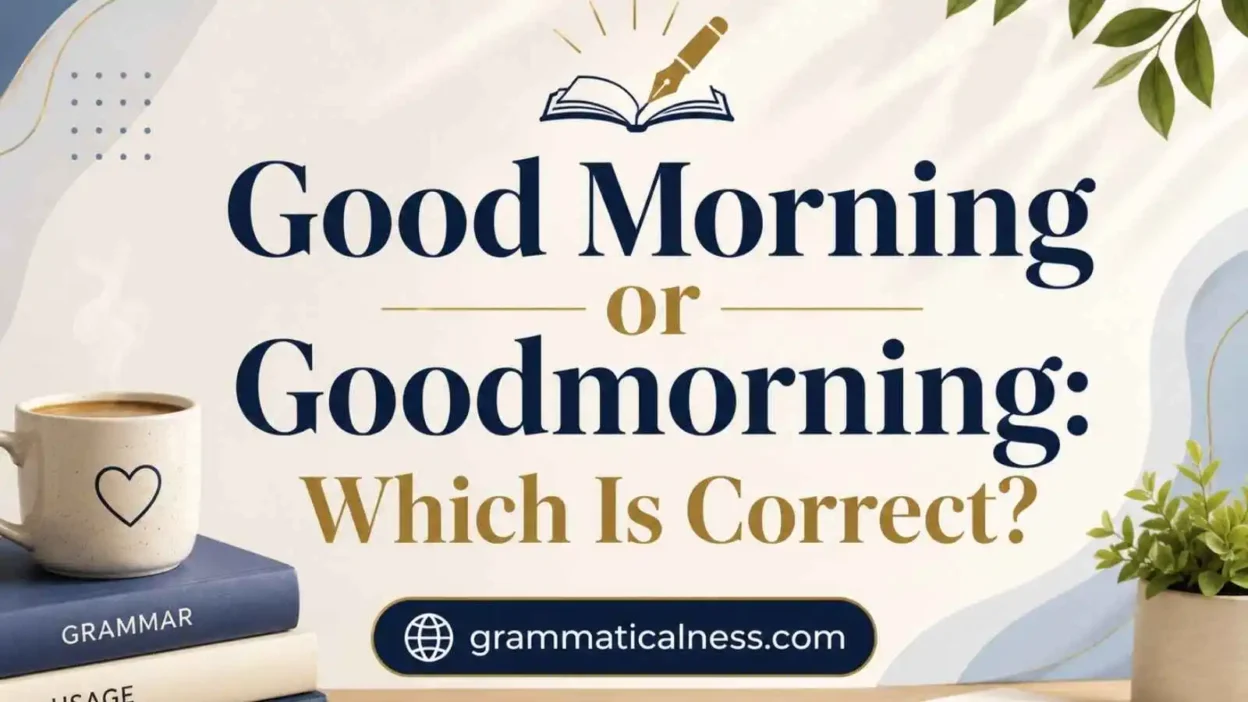
The correct choice is good morning.
Write it as two words. Goodmorning is not standard in US English. It is best treated as a spacing mistake, even if you sometimes see it in texts, usernames, captions, or quick posts.
This is not a deep meaning difference. Both forms point to the same morning greeting, but only one is correct in normal writing.
Quick Answer
Use good morning when you greet someone in the morning.
Do not use goodmorning in emails, schoolwork, business messages, signs, or polished writing.
Correct: Good morning, Maya.
Incorrect: Goodmorning, Maya.
When the phrase starts a sentence or greeting, capitalize Good. You do not need to capitalize morning unless the whole phrase is part of a title, heading, or subject line style.
Why People Confuse Them
People confuse good morning and goodmorning because the phrase sounds smooth when spoken. There is no pause between the two words.
Typing habits also play a part. In quick texts, people often run words together. That does not make the one-word form standard.
English has many closed compounds, such as sunrise and notebook. But good morning has not become one of those standard one-word compounds. It stays open, with a space between the words.
Just like “good morning” vs. “goodmorning,” many writers also confuse “at least” and “atleast”—especially when it comes to correct spacing and standard English usage.
Key Differences At A Glance
| Context | Best Choice | Why |
| Work email | good morning | Standard and professional |
| Text to a friend | good morning | Still the correct spelling |
| School assignment | good morning | Accepted written form |
| Greeting a group | good morning | Natural and clear |
| Username or brand style | goodmorning | Only if intentionally styled as a name |
| Formal letter | good morning | The one-word form looks careless |
| Social caption | good morning | Correct even in casual writing |
The main point is simple: good morning is the normal phrase. Goodmorning is usually an error unless it is being used as a stylized handle, label, or brand name.
Meaning and Usage Difference
Good morning is a greeting. It means something like “hello” in the morning.
Example: Good morning, everyone. Thanks for joining the call.
The words have separate jobs. Good describes the kind of morning being wished or acknowledged. Morning names the time of day.
Goodmorning does not have a separate standard meaning. It is not a different greeting with a different tone. It is simply the same phrase written without the needed space.
A compact way to see it:
• good morning: correct two-word greeting
• goodmorning: nonstandard one-word spelling
• Good Morning: possible in a title or subject line, but not needed in a normal sentence
• Morning!: casual shortened greeting
Tone, Context, and Formality
Good morning works in both formal and casual settings. You can use it with your boss, a client, a teacher, a neighbor, or a friend.
It sounds polite, clear, and ordinary.
Goodmorning looks informal at best and incorrect at worst. In a business email, it can make the message look rushed. In school writing, it will likely be marked as a spelling mistake.
Compare these:
Correct: Good morning, Dr. Patel. I attached the report.
Incorrect: Goodmorning, Dr. Patel. I attached the report.
In casual texting, the mistake may not block understanding. Your reader will know what you mean. Still, the correct form is good morning.
Which One Should You Use?
Use good morning almost every time.
Use it when you are:
• opening an email
• greeting a team
• texting a friend
• writing a card
• starting a meeting
• posting a morning message
• writing dialogue
You should only use goodmorning if it is part of an exact name, handle, tag, or design choice. For example, a café could style its account name as @goodmorningcoffee. That does not change the correct phrase in normal writing.
For regular sentences, keep the space.
When One Choice Sounds Wrong
Goodmorning sounds wrong in writing because it joins two words that standard English keeps separate.
These look wrong:
Goodmorning, class.
I said goodmorning to the front desk clerk.
She sent a goodmorning text.
Fix them like this:
Good morning, class.
I said good morning to the front desk clerk.
She sent a good morning text.
The last example shows a useful point. Good morning can also work before another noun, as in good morning text or good morning message. It still stays two words.
If you enjoy learning about commonly confused word forms and spacing rules, don’t miss our detailed guide on “Awhile or A While” to understand when each version is grammatically correct.
Common Mistakes (and Quick Fixes)
One common mistake is writing the greeting as one word.
Wrong: Goodmorning, team.
Right: Good morning, team.
Another mistake is adding a hyphen.
Wrong: Good-morning, team.
Right: Good morning, team.
A third mistake is capitalizing both words in a normal sentence.
Less natural: She said Good Morning to the team.
Better: She said good morning to the team.
Use a comma when you directly address someone.
Right: Good morning, Alex.
Right: Good morning, everyone.
The comma helps separate the greeting from the person or group being addressed.
Everyday Examples
Here are natural US-English examples of good morning:
Good morning, Jordan. Did you see the updated schedule?
Good morning, everyone. Let’s get started.
I said good morning to the new receptionist.
She sent a good morning text before her flight.
Good morning! I hope your Monday is off to a calm start.
He walked into the kitchen and gave everyone a sleepy good morning.
Now compare those with the incorrect form:
Incorrect: Goodmorning, Jordan.
Correct: Good morning, Jordan.
Incorrect: She sent a goodmorning text.
Correct: She sent a good morning text.
Incorrect: I forgot to say goodmorning.
Correct: I forgot to say good morning.
Dictionary-Style Word Details
Verb
• good morning: Not commonly used as a verb in standard US English. You would not normally say, “She good-morninged the room.” Write She said good morning instead.
• goodmorning: Not used as a verb in standard US English.
Noun
• good morning: Can work as a noun phrase when you mean the greeting itself.
Example: He gave me a quick good morning before heading to his desk.
• goodmorning: Not a standard noun in US English. If you mean the greeting, write good morning.
Synonyms
• good morning: Closest plain alternatives include morning, hello, hi, and greetings. These are not exact matches in every situation because good morning is tied to the morning.
Useful opposites by time of day include good afternoon, good evening, and good night, but they are not direct antonyms in the strict sense. They are related greetings used at different times.
• goodmorning: No true synonyms as a standard word because it is not the accepted spelling. The intended phrase is good morning.
Example Sentences
• good morning: Good morning, Ms. Rivera. Thanks for meeting with me.
• good morning: I waved and said good morning to my neighbor.
• good morning: He sent a good morning message before work.
• goodmorning: Goodmorning, Ms. Rivera is not standard. Write Good morning, Ms. Rivera.
• goodmorning: I sent a goodmorning message should be I sent a good morning message.
Word History
• good morning: The phrase is built from the separate words good and morning. Major dictionaries treat it as the two-word greeting good morning. Its exact development is not needed to choose the correct modern form.
• goodmorning: No clear standard word history supports goodmorning as the accepted form of this greeting in modern US English. It is best understood as a modern spacing error or a stylized form in names and handles.
Phrases Containing
• good morning: Common phrases include good morning message, good morning text, good morning email, good morning greeting, and say good morning.
• goodmorning: Not commonly used in standard phrases. You may see it in usernames, hashtags, or decorative text, but that does not make it correct in regular writing.
FAQs
“Good morning” is always written as two separate words. It is a standard greeting used when meeting, speaking to, or writing to someone during the morning. Writing it as “goodmorning” is incorrect in standard English.
No. “Goodmorning” is not accepted as a standard English word. The correct spelling is “good morning.” Even though people sometimes combine the words in casual texts, social media posts, or hashtags, formal and standard writing requires two words.
Capitalize both words when “Good Morning” appears in a title, heading, card, or subject line. In a normal sentence, capitalization depends on position. For example, write “Good morning, Sarah” at the beginning of a sentence but “I said good morning to everyone” within a sentence.
Yes. “Good morning” is a polite and natural email greeting, especially when you expect the recipient to read the message in the morning. You can write “Good morning, John,” before beginning the main message.
“Good morning” works in both formal and informal situations. You can use it with coworkers, teachers, clients, friends, family members, and strangers. Its tone depends largely on the context and the words that follow it.
Both can be used as greetings, but “good morning” sounds more complete and slightly more polite. “Morning” is shorter and more casual. In professional communication, “good morning” is usually the safer choice, while “morning” works well in relaxed conversations.
Conclusion
Choose good morning, not goodmorning.
The difference is not about meaning, formality, or US versus UK style. It is mainly about correct spacing. Good morning is the standard two-word greeting. Goodmorning is usually a mistake.
For emails, texts, school writing, and everyday messages, write it with a space: Good morning.