
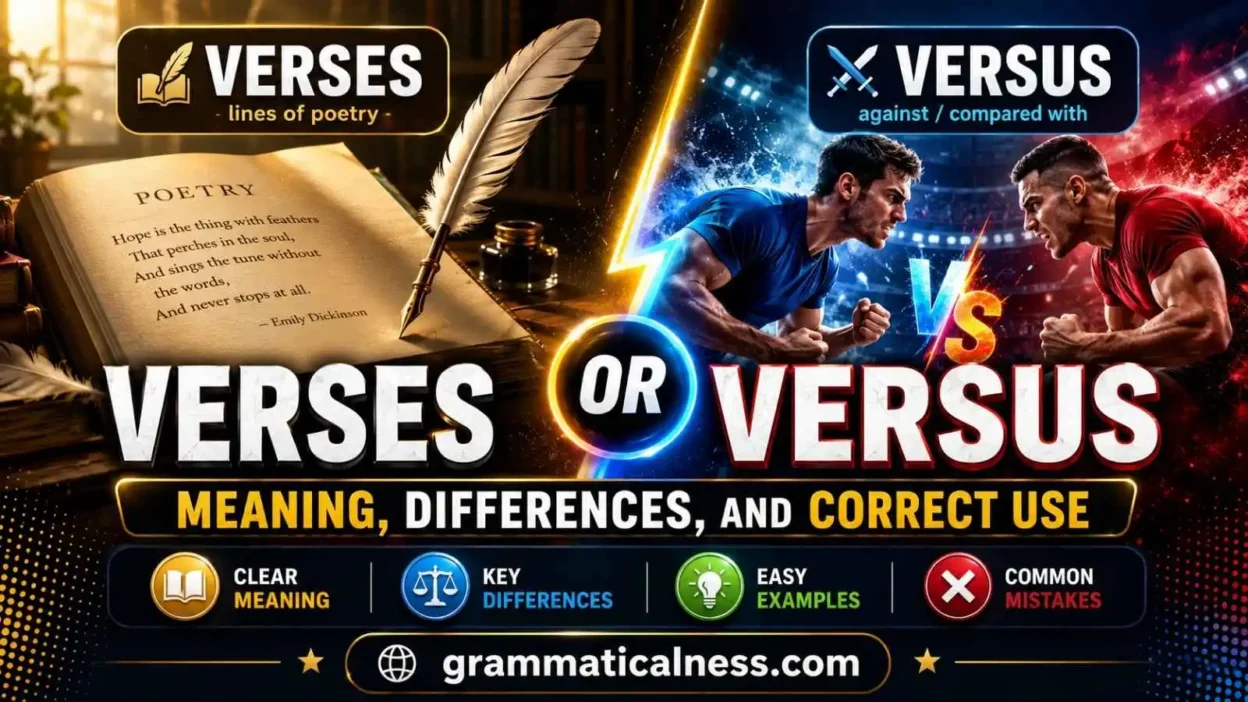
Both verses and versus are correct English words, but they do completely different jobs.
Use verses when you mean more than one section of a poem, song, or religious text. Use versus when two people, teams, ideas, products, or choices compete or receive comparison.
For example:
- We practiced the final two verses of the song.
- Tonight’s game features Chicago versus Miami.
The words look and sound similar, so writers sometimes replace one with the other. Their meanings, however, are not interchangeable.
Quick Answer
Use verses as the plural of verse. It refers to lines or sections of poetry, songs, or scripture.
Use versus to mean against, compared with, or in contrast to.
Correct: The class compared online learning versus classroom learning.
Incorrect: The class compared online learning verses classroom learning.
Why People Confuse Them
The confusion begins with sound. Many American speakers pronounce versus as “VER-sus” and verses as “VER-siz.” In fast conversation, the endings may sound nearly identical.
People also hear versus often in sports before they see it written. A child may hear “Lakers versus Celtics” and assume that the speaker said “Lakers verses Celtics.”
That misunderstanding can produce informal forms such as:
- We will verse them tomorrow.
- Our team is versing theirs.
- We versed them last week.
Some speakers use these forms casually, especially when discussing games. However, standard edited American English normally uses play, face, compete against, or go against instead.
Correct: We will play against them tomorrow.
Correct: Our team faces theirs tonight.
Key Differences At A Glance
- Verses: Usually a plural noun; refers to sections of poetry, songs, or scripture.
- Versus: A preposition; introduces an opponent, alternative, or contrasting item.
- Verses: Does not normally mean “against.”
- Versus: Can appear in full or as vs., vs, or v., depending on context and style.
- Pronunciation: The words may sound similar, but many speakers give them slightly different final syllables.
The easiest memory aid connects verses with verse. When you can replace the word with “song sections,” “poetry lines,” or “scripture passages,” choose verses.
When you can replace it with against or compared with, choose versus.
Meaning and Usage Difference
Verses most commonly functions as the plural form of the noun verse.
A verse may refer to a section of a song:
The first verse begins quietly.
With more than one section, use verses:
The first two verses begin quietly.
The word can also refer to poetry:
She wrote several humorous verses for the school magazine.
In religious writing, verses may name numbered portions of a chapter:
He read three verses from the passage.
Versus functions as a preposition. It connects two sides that compete, oppose each other, or receive comparison.
Competition:
The final will be Dallas versus Seattle.
Legal opposition:
The case involved the state versus the defendant.
Comparison:
We discussed renting versus buying a home.
Alternatives:
The family considered driving versus taking the train.
Although verses can technically appear as a rare form of the verb verse, that use usually means composing poetry. It does not make verses the standard word for competition.
For a trusted dictionary explanation, Merriam-Webster explains that versus means “against,” while verses is the plural of verse.
Tone, Context, and Formality
Both words have a neutral tone when writers use them correctly.
Verses works naturally in everyday, literary, musical, educational, and religious contexts. It does not sound especially formal or informal.
Versus also works in both formal and casual writing. The complete spelling often reads best in normal sentences:
The report compares remote work versus office work.
The abbreviation vs. commonly appears in headlines, labels, charts, game listings, and short comparisons:
Remote Work vs. Office Work
In American legal writing, v. often separates the names of opposing parties:
Brown v. Board of Education
Casual speakers sometimes shorten versus so strongly that it sounds like verse. That pronunciation may explain the confusion, but formal and carefully edited writing should preserve the correct spelling.
Which One Should You Use?
Use the surrounding meaning to make your choice.
| Context | Best Choice | Why |
| Multiple parts of a song | verses | It is the plural of verse. |
| Lines or sections of poetry | verses | The word names poetic material. |
| Numbered parts of scripture | verses | It refers to multiple text divisions. |
| Two competing teams | versus | It means against. |
| Comparing products or choices | versus | It means compared with or in contrast to. |
| Opposing parties in a case | versus | It identifies the two sides. |
| A short matchup title | versus or vs. | Both can introduce opposing sides. |
Try this quick replacement test:
If against fits, use versus.
The Hawks are playing against the Bears.
The Hawks versus the Bears.
If sections or passages fits, use verses.
We studied three passages from the chapter.
We studied three verses from the chapter.
When One Choice Sounds Wrong
Verses sounds wrong when the sentence describes competition or comparison.
Incorrect: Tonight is Boston verses New York.
Correct: Tonight is Boston versus New York.
Incorrect: We compared gas cars verses electric cars.
Correct: We compared gas cars versus electric cars.
In these sentences, the writer needs a word meaning against or compared with. The plural noun verses cannot provide that meaning.
Versus sounds wrong when the sentence refers to parts of a song, poem, or religious text.
Incorrect: I memorized two versus from the poem.
Correct: I memorized two verses from the poem.
Incorrect: The song has four versus and a repeated chorus.
Correct: The song has four verses and a repeated chorus.
Here, the writer needs a plural noun naming sections of written or sung material.
Common Mistakes (and Quick Fixes)
Mistake: The Tigers will verse the Lions.
Quick fix: The Tigers will play against the Lions.
In casual conversation, some people use verse as a competition verb. Standard writing usually prefers play, face, or compete against.
Mistake: Which is better, renting verses buying?
Quick fix: Which is better, renting versus buying?
The sentence compares two alternatives, so versus fits.
Mistake: The final versus were difficult to sing.
Quick fix: The final verses were difficult to sing.
The sentence refers to song sections, so use the plural noun.
Mistake: I highlighted five versus in the chapter.
Quick fix: I highlighted five verses in the chapter.
The sentence refers to numbered passages.
Mistake: Writing “vs.” in every full sentence.
Quick fix: Use versus in ordinary prose when the full word reads more naturally. Save vs. for short labels, titles, schedules, and compact comparisons.
Everyday Examples
The choir repeated the final two verses.
My favorite verses appear near the end of the poem.
The teacher asked us to read several verses aloud.
Jordan could remember the chorus but forgot the verses.
Saturday’s schedule lists Phoenix versus Denver.
The debate focused on privacy versus convenience.
We compared the monthly cost of leasing versus buying.
The workshop examined speed versus accuracy.
Our class discussed printed books versus digital books.
The article compares working alone versus working with a team.
The songwriter revised the opening verses before recording.
The coach reviewed our record versus stronger opponents.
Dictionary-Style Word Details
Verb
Verses: Can serve as the third-person singular form of the rare verb verse, meaning to compose or express something in verse. This use sounds literary or uncommon in modern American English.
Example: The poet verses an old story in a new form.
Some speakers also use verse informally to mean competing against someone. In standard edited writing, plays, faces, or competes against usually works better.
Versus: Not commonly used as a verb in standard US English. It normally functions as a preposition.
Noun
Verses: Commonly used as a plural noun. It refers to multiple lines or sections of a poem, song, or religious text.
Example: She memorized the first three verses.
Versus: Not commonly used as a noun in ordinary standard English. It normally appears between two opposing or contrasting items.
Synonyms
Verses: Exact alternatives depend on context. Closest plain alternatives include stanzas, lines, passages, and sections. These words are not interchangeable in every sentence.
Versus: Closest alternatives include against, compared with, in contrast to, and as opposed to.
Neither word has one clear antonym that fits all its meanings.
Example Sentences
Verses:
- The children practiced two verses before the concert.
- These verses describe the changing seasons.
- She marked several verses for later discussion.
Versus:
- The championship game is Atlanta versus Houston.
- The guide compares saving versus spending.
- We debated convenience versus long-term cost.
Word History
Verses: Comes from the singular noun verse. Its history reaches back through French and Latin forms connected with a line of writing and the idea of turning from one line to the next.
Versus: Entered English from Latin. Its earlier sense involved turning toward or facing something, which later supported meanings connected with opposition and contrast.
The words share distant historical connections, but modern English assigns them separate meanings and grammatical roles.
Phrases Containing
Verses:
- Bible verses
- song verses
- opening verses
- lines of verse
- several verses
- verses from a poem
Versus:
- versus the competition
- one versus one
- nature versus nurture
- quality versus quantity
- renting versus buying
- Team A versus Team B
FAQs
Is it verses or versus in sports?
Use versus in sports because it means “against.”
Example: Tonight’s game is Miami versus Boston.
Is verses the plural of verse?
Yes. Verses is the plural form of verse. It refers to sections of a song, poem, or religious text.
Example: She memorized three verses from the poem.
Can I write Team A verses Team B?
No. Write Team A versus Team B because the teams compete against each other. You may also use vs. in schedules, titles, and scoreboards.
Are verses and versus pronounced the same?
They often sound similar in fast speech, but many speakers pronounce them differently. Verses usually sounds like “VER-siz,” while versus sounds like “VER-sus.”
Is “we are versing them” correct?
People sometimes use versing informally, especially in casual sports conversations. However, standard American English usually prefers playing against, facing, or competing against.
Correct: We are playing against them tomorrow.
When should I use versus in comparisons?
Use versus when you compare two choices, ideas, products, or actions.
Examples:
- Renting versus buying
- Online classes versus classroom learning
- Quality versus quantity
Can versus be shortened?
Yes. Writers often shorten versus to vs. in headings, game listings, charts, and short comparisons. Legal case names commonly use v.
What is the easiest way to remember the difference?
Use verses for song sections, poetry lines, or scripture passages. Use versus when you can replace the word with against or compared with.
Conclusion
Use verses for multiple sections of poetry, songs, or scripture. Use versus when two sides compete or when you compare two ideas, products, actions, or choices.
Remember the replacement test:
- Sections, lines, or passages → verses
- Against or compared with → versus
The teams play versus each other, while singers perform the verses.
Use versus in sports because it means “against.”
Example: Tonight’s game is Miami versus Boston.
Yes. Verses is the plural form of verse. It refers to sections of a song, poem, or religious text.
Example: She memorized three verses from the poem.
No. Write Team A versus Team B because the teams compete against each other. You may also use vs. in schedules, titles, and scoreboards.
They often sound similar in fast speech, but many speakers pronounce them differently. Verses usually sounds like “VER-siz,” while versus sounds like “VER-sus.”
People sometimes use versing informally, especially in casual sports conversations. However, standard American English usually prefers playing against, facing, or competing against.
Correct: We are playing against them tomorrow.
Use versus when you compare two choices, ideas, products, or actions.
Examples:
Renting versus buying
Online classes versus classroom learning
Quality versus quantity
Yes. Writers often shorten versus to vs. in headings, game listings, charts, and short comparisons. Legal case names commonly use v.
Use verses for song sections, poetry lines, or scripture passages. Use versus when you can replace the word with against or compared with.