
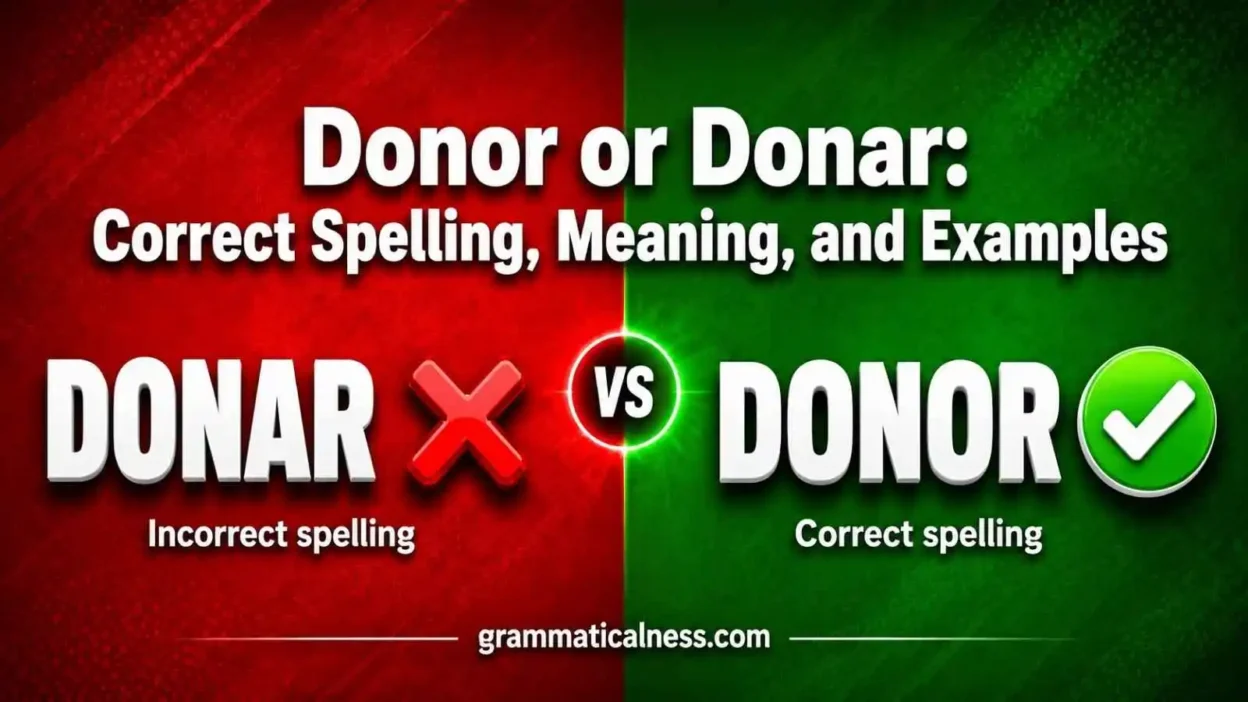
Donor or donar is a common spelling question, especially in school essays, charity pages, medical forms, and workplace messages. The correct word in standard US English is donor.
In simple terms, a donor is a person, group, company, or organization that gives something. That gift may be money, blood, organs, tissue, goods, time, or support. By contrast, donar is not the standard English spelling for that meaning, so it usually looks like an error.
Quick Answer
Donor is correct in standard US English. Donar is not the correct spelling when you mean a person or organization that gives something. Therefore, write blood donor, organ donor, charity donor, and major donor. Although Donar can appear as a capitalized name, it is not the English noun for a giver.
Why People Confuse Them
People often confuse donor and donar because of pronunciation. In everyday American speech, donor usually sounds like DOH-ner. Since the ending is soft, some writers guess that the word should end in -ar.
However, that guess does not match standard English spelling. The correct ending is -or, just as it is in words like actor, creator, and advisor. For that reason, donor is the form to use in clean, professional writing.
Another reason for the mistake is the word family. Writers see donate and donation, and then they may assume the giver should be a donar. Instead, English uses this pattern: donate, donation, donor.
Key Differences At A Glance
| Context | Best Choice | Why |
| A person who gives money | donor | This is the standard noun. |
| A person who gives blood | donor | Medical writing uses “blood donor.” |
| A person who gives an organ | donor | “Organ donor” is the accepted phrase. |
| A charity supporter | donor | Nonprofit and fundraising writing use this spelling. |
| A school essay or email | donor | It is the correct English spelling. |
| A mythological name | Donar | Capitalized Donar is a separate proper noun. |
| Casual texting | donor | The correct spelling still works in informal writing. |
| “Blood donar” | donor | “Donar” makes the phrase look misspelled. |
Meaning and Usage Difference
Donor means someone or something that gives, donates, or provides something. It is a noun, and it works in both everyday and formal writing.
For example, a person can be a blood donor. A company can be a corporate donor. Likewise, a person who supports a scholarship fund can be called a donor.
Donar, on the other hand, is not the standard English spelling for a giver. If you write “She is a generous donar,” most readers will understand the meaning, but they will also see the spelling as incorrect.
There is one narrow exception. Donar, with a capital D, can appear as a proper name connected with mythology. Still, that is a separate use, not an alternate spelling of donor in normal US English.
Pronunciation can help you remember the choice:
Donor: DOH-ner
Donar as a name: often DOH-nahr
Because the regular English word is donor, use that spelling for charity, medicine, education, and business writing.
Tone, Context, and Formality
Donor is neutral, standard, and appropriate in almost every context. You can use it in a school report, a hospital form, a nonprofit email, a news story, or a thank-you note.
In addition, donor works naturally in both formal and casual writing. A doctor can say “organ donor,” while a friend can say, “I became a blood donor today.” The word does not sound too stiff or too casual.
By comparison, donar looks wrong when it is used for a giver. In formal writing, it can make the sentence seem careless. In medical or charity writing, it may also distract readers because they expect the standard spelling.
There is no useful US vs UK difference here. For the meaning “one who gives,” standard English uses donor.
Which One Should You Use?
Use donor when you are writing in English and mean a person or organization that gives something.
Choose donor for:
A donor can be someone who gives money.
They may also give blood or donate an organ.
In each case, the giver is called a donor.
A company that supports a cause
A supporter of a school, hospital, church, campaign, or nonprofit
Avoid donar in those cases. Instead, use it only if it is part of a proper name, a surname, a title, or a specific non-English context. For ordinary US English, though, donor is the correct choice.
When One Choice Sounds Wrong
Donor sounds natural in common English phrases. For instance, writers often use blood donor, organ donor, major donor, anonymous donor, and corporate donor.
By contrast, donar sounds wrong in those same phrases:
Blood donar
Organ donar
Major donar
Anonymous donar
Corporate donar
Individual donar
Donar card
Donar list
Even when the meaning is clear, the spelling can weaken the sentence. Therefore, use donor whenever you mean someone who gives.
Common Mistakes (and Quick Fixes)
Mistake: “The donar gave $500 to the school.”
Fix: “The donor gave $500 to the school.”
Mistake: “I want to become a blood donar.”
Fix: “I want to become a blood donor.”
Mistake: “The hospital needs more organ donars.”
Fix: “The hospital needs more organ donors.”
Mistake: “Thank you to every donar.”
Fix: “Thank you to every donor.”
Mistake: “Donar” used because it sounds like “donate.”
Fix: Remember the correct word family: donate, donation, donor.
As a quick rule, look at the final two letters. If you mean a giver, the word should end in -or, not -ar.
Everyday Examples
The anonymous donor paid for the new library books.
After work, Mia signed up to become a blood donor.
Because he wanted to help others, Luis became an organ donor.
At the event, the museum honored a major donor.
Next month, our school hopes to find one more donor for the scholarship fund.
Before giving blood, each donor must show a photo ID.
In addition, a local business became a monthly donor.
The nonprofit sent receipts to all donors after the fundraiser.
Incorrect: The charity thanked each donar.
Correct: The charity thanked each donor.
Incorrect: He is a regular blood donar.
Correct: He is a regular blood donor.
Dictionary-Style Word Details
Verb
Donor: Not commonly used as a verb in standard US English. Instead, use donate as the verb.
Example: She plans to donate blood next week.
Donar: Not a standard English verb meaning “to donate.” For example, do not write “I will donar money.” Write “I will donate money.”
Noun
Donor: A standard noun meaning a person, organization, or source that gives something. It can also appear before another noun in phrases such as donor organs, donor funds, and donor records.
Donar: Not the standard English noun for a giver. However, capitalized Donar can be a proper noun in mythology, which is a different use.
Synonyms
Donor: Closest plain alternatives include giver, contributor, benefactor, supporter, patron, and backer. However, these words are not always exact replacements. For example, blood donor is much more natural than blood benefactor.
Useful opposites may include recipient or receiver, since those words name the person who receives rather than gives.
Donar: No useful English synonyms apply when it is used as a misspelling of donor. If you mean a giver, the correct word is donor.
Example Sentences
Donor: The donor asked to remain anonymous.
Blood donor: A blood donor can help patients in urgent need.
University donors: The university thanked its donors in the annual report.
Donar: Do not write “The donar gave money.” Instead, write “The donor gave money.”
Donar: Do not write “organ donar.” Instead, write “organ donor.”
Word History
Donor: The word comes through older French and Latin roots connected with giving. For modern writers, however, the practical point is simple: the standard English spelling is donor.
Donar: Capitalized Donar has a separate history as a mythological name. That separate use does not make lowercase donar correct for a person who gives money, blood, organs, or support.
Phrases Containing
Donor: blood donor, organ donor, donor card, donor list, donor funds, major donor, anonymous donor, corporate donor, sperm donor, egg donor, universal donor.
Donar: No standard US English giving phrases use donar. Therefore, write blood donor, not blood donar. Also, write organ donor, not organ donar.
FAQs
Is donor or donar correct?
Donor is correct in standard US English. It means a person, group, company, or organization that gives something, such as money, blood, organs, goods, or support. Donar is not the correct English spelling for that meaning, so avoid it in school, work, charity, and medical writing.
Is donar a real word?
Donar can appear as a capitalized proper name, especially in mythological contexts. However, lowercase donar is not the standard English word for someone who gives. If you mean a giver or contributor, the correct word is donor.
Why do people write donar instead of donor?
People often write donar because donor sounds like “DOH-ner” in everyday speech. Since the final sound is soft, some writers guess the spelling incorrectly. Still, the correct ending is -or, not -ar.
What is a donor?
A donor is someone who gives something to help another person, group, or cause. For example, a blood donor gives blood, an organ donor gives organs or tissue, and a charity donor gives money or other support.
Can I write blood donar?
No. The correct phrase is blood donor. The spelling blood donar is incorrect in standard English. Similarly, write organ donor, major donor, anonymous donor, and charity donor.
What is the easiest way to remember donor?
Connect donor with donate and donation, but remember: the person who gives is a donor.
Memory tip: A donor gives, and donor ends in -or.
Conclusion
The choice between donor or donar is straightforward. Use donor when you mean someone or something that gives. It is the correct spelling for charity, blood, organs, tissue, money, goods, school funds, and professional messages.
Avoid donar for that meaning because it is not the accepted English spelling. Although capitalized Donar can exist as a separate name, that is not the word you need in everyday writing. When in doubt, choose donor.
Donor is correct in standard US English. It means a person, group, company, or organization that gives something, such as money, blood, organs, goods, or support. Donar is not the correct English spelling for that meaning, so avoid it in school, work, charity, and medical writing.
Donar can appear as a capitalized proper name, especially in mythological contexts. However, lowercase donar is not the standard English word for someone who gives. If you mean a giver or contributor, the correct word is donor.
People often write donar because donor sounds like “DOH-ner” in everyday speech. Since the final sound is soft, some writers guess the spelling incorrectly. Still, the correct ending is -or, not -ar.
A donor is someone who gives something to help another person, group, or cause. For example, a blood donor gives blood, an organ donor gives organs or tissue, and a charity donor gives money or other support.
No. The correct phrase is blood donor. The spelling blood donar is incorrect in standard English. Similarly, write organ donor, major donor, anonymous donor, and charity donor.
Connect donor with donate and donation, but remember: the person who gives is a donor.
Memory tip: A donor gives, and donor ends in -or.