
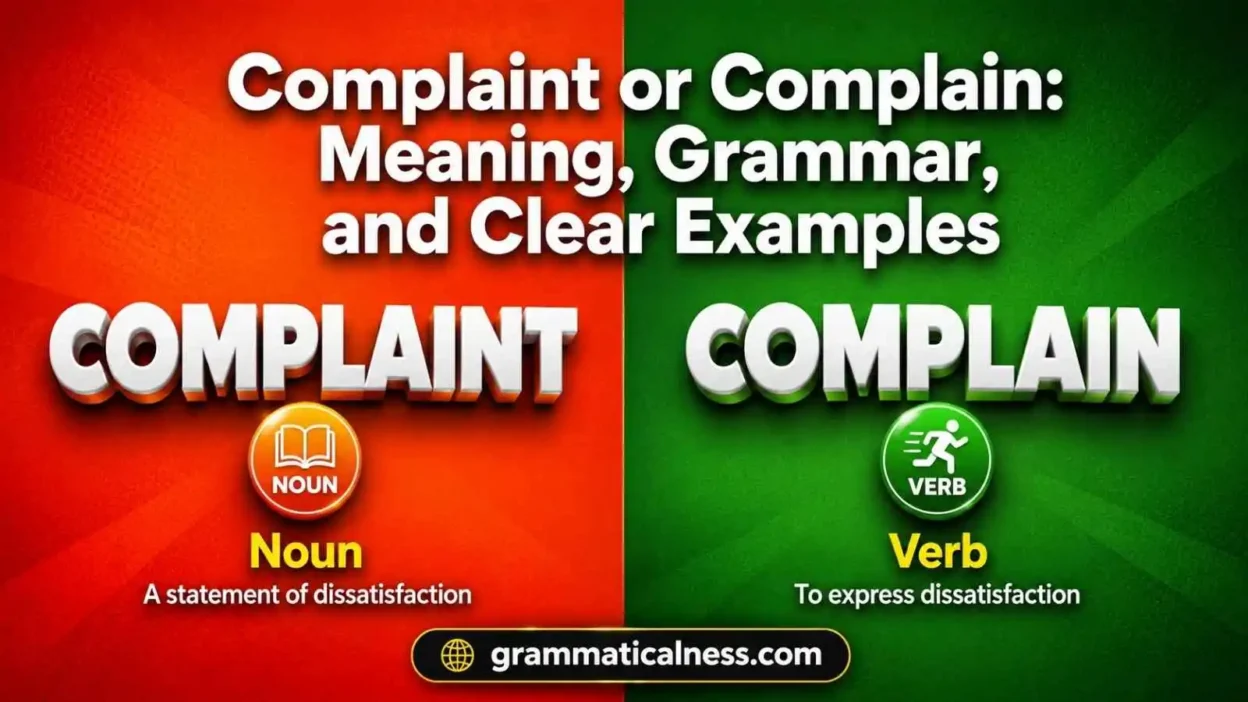
The correct choice depends on grammar. Use complaint when you need a noun. Use complain when you need a verb.
A complaint is the problem, report, statement, or reason someone is unhappy. By contrast, complain means to say that something is wrong, unfair, painful, or not good enough.
So, the basic rule is simple: you make a complaint, but you complain about something.
Quick Answer
Use complaint for a thing.
Use complain for an action.
Correct: I filed a complaint about the late delivery.
Correct: I need to complain about the late delivery.
Wrong: I filed a complain.
Wrong: I need to complaint.
Here is an easy test. If you can put a, the, my, or your before the word, you probably need complaint. However, if the word shows what someone does, you probably need complain.
Why People Confuse Them
People confuse complaint and complain because they look alike, sound alike, and share the same basic idea. Both words connect to expressing a problem.
Still, they do not work the same way in a sentence. Complaint names the issue. Meanwhile, complain shows the action.
Pronunciation can add to the confusion, too. Complaint sounds like “kuhm-PLAYNT,” with a final t sound. Complain sounds like “kuhm-PLAYN,” without that final t.
Because the words are closely related, many writers use one in place of the other. However, once you know the noun-versus-verb difference, the choice becomes much easier.
Key Differences At A Glance
| Feature | Complaint | Complain |
|---|---|---|
| Main grammar role | Noun | Verb |
| Basic meaning | A problem, report, or statement of dissatisfaction | To express dissatisfaction |
| Common pattern | make/file/receive a complaint | complain about/to/that/of |
| Example | She made a complaint. | She complained about the service. |
| Common mistake | “make a complain” | “I want to complaint” |
Meaning and Usage Difference
A complaint is something you can have, make, file, receive, read, handle, or resolve. In other words, it is a thing.
For example, you can have a complaint about your phone bill. A company can receive a customer complaint. Also, a patient can report a medical complaint, and a person can file a legal complaint.
Complain, on the other hand, is what someone does when they speak up about a problem.
For example, you can complain about a noisy neighbor. You can complain to a manager. Also, you can complain that the service was slow. In medical settings, a patient may complain of chest pain.
The sentence pattern usually tells you which word you need. Complaint often appears with words like a, the, my, your, or customer. Meanwhile, complain changes form like other verbs: complain, complains, complained, and complaining.
Confused between “take effect” and “take affect”? Learn the correct usage instantly here: Take Effect vs Take Affect (Quick Grammar Guide)
Tone, Context, and Formality
Complaint can sound formal in phrases like file a complaint, submit a complaint, or legal complaint. Therefore, it is common in customer service, workplace reports, medical notes, and legal writing.
Even so, complaint is not always formal. A sentence like “My only complaint is the parking” sounds natural in everyday US English.
Complain can also be neutral when someone has a real issue. For example, “Please complain to the manager if your order is wrong” sounds reasonable and direct.
However, complain can sound negative if it suggests someone is upset too often or without a strong reason. For instance, “He complains about everything” sounds critical.
So, the tone depends on context. The grammar rule, however, stays the same.
Which One Should You Use?
| Context | Best Choice | Why |
|---|---|---|
| Naming the problem | complaint | You need a noun. |
| Describing the action | complain | You need a verb. |
| Customer service email | complaint | You may be naming or filing a report. |
| Talking to a manager | complain | You are describing the act of speaking up. |
| Medical symptoms | complaint | The symptom can be called a complaint. |
| Saying someone reported pain | complain | The person complains of pain. |
| Legal document | complaint | It can mean a formal legal filing. |
| Casual frustration | complain | It describes what someone is doing. |
Choose complaint when the word names the issue. Choose complain when the word shows the action.
As a quick shortcut, remember this pattern: someone complains, but someone makes a complaint.
When One Choice Sounds Wrong
Complaint sounds wrong when the sentence needs an action word.
Wrong: I want to complaint about the noise.
Correct: I want to complain about the noise.
In this sentence, the person wants to do something. Therefore, the verb complain is correct.
Complain sounds wrong when the sentence needs a noun.
Wrong: I made a complain about the noise.
Correct: I made a complaint about the noise.
Here, the sentence needs the name of the report or issue. As a result, complaint is the right choice.
Also, pay attention to the words around each term. In standard US English, people usually complain about a problem and make a complaint about a problem.
Common Mistakes (and Quick Fixes)
Mistake: “I have a complain.”
Fix: “I have a complaint.”
Mistake: “She sent a complain to support.”
Fix: “She sent a complaint to support.”
Mistake: “They complaint about the new fee.”
Fix: “They complain about the new fee.”
Mistake: “He complained a complaint.”
Fix: “He made a complaint.”
Also correct: “He complained about it.”
Mistake: “Please complaint to the front desk.”
Fix: “Please complain to the front desk.”
To fix most errors, ask one question: Am I naming the issue, or describing the action? If you are naming the issue, use complaint. If you are describing the action, use complain.
Everyday Examples
I have a complaint about my internet bill.
The tenant filed a complaint after the heat stopped working.
My only complaint is that the room was too cold.
Please don’t complain until we know what happened.
Several customers complained about the long wait.
She plans to complain to the airline about the canceled flight.
The patient complained of back pain after the accident.
The office received three complaints about the new parking rule.
In each example, the grammar controls the choice. Complaint names the issue, while complain describes the action.
Dictionary-Style Word Details
Verb
• Complaint: Not commonly used as a verb in standard US English. Instead, use complain when you need the action.
Example: She complained about the service.
• Complain: A verb meaning to say that something is wrong, unfair, painful, or not satisfactory. It is often followed by about, to, that, or of.
Example: They complained about the delay.
Noun
• Complaint: A noun. It can mean a statement of dissatisfaction, the issue being reported, a medical symptom, or a formal legal filing.
Example: The company responded to my complaint.
• Complain: Not commonly used as a noun in standard US English. Therefore, say a complaint, not a complain.
Example: We received a complaint.
Synonyms
• Complaint: Closest plain alternatives include grievance, objection, concern, criticism, or formal report, depending on the context. Useful opposites include compliment or praise when the meaning is an expression of approval.
• Complain: Closest plain alternatives include object, protest, grumble, gripe, or report a problem. However, grumble and gripe are more casual and can sound negative.
Example Sentences
• Complaint: We submitted a complaint after the repair company missed two appointments.
• Complaint: Her main complaint was the lack of clear instructions.
• Complain: Customers often complain when fees are not explained upfront.
• Complain: He did not complain about the mistake, but he asked for it to be fixed.
Word History
• Complaint: The word is historically tied to older forms connected with lamenting or expressing distress. Today, though, the most important point is its noun role.
• Complain: This word comes from the same broad word family, but its modern job is different. It works as the verb.
The history helps explain why the words feel related. However, modern grammar is what matters most when choosing between them.
Phrases Containing
• Complaint: make a complaint, file a complaint, submit a complaint, customer complaint, letter of complaint, complaint about, complaint against, grounds for complaint.
• Complain: complain about, complain to, complain that, complain of, can’t complain.
These phrases are useful because they show the normal sentence patterns. For example, you can file a complaint, but you do not file a complain.
FAQs
Is “complaint” or “complain” correct?
Both are correct, but they do different jobs. Complaint is a noun, while complain is a verb. For example, say “I have a complaint” when naming the issue. However, say “I want to complain” when describing the action.
Do you say “make a complaint” or “make a complain”?
The correct phrase is make a complaint. Since complaint names the issue or report, it works after words like make, file, or submit. By contrast, complain is an action word, so it does not fit after “make a.”
Correct: I want to make a complaint.
Wrong: I want to make a complain.
Can “complaint” be used as a verb?
No, complaint is not used as a verb in standard US English. Instead, use complain when you mean the action of speaking up about a problem.
Correct: She complained about the service.
Wrong: She complaint about the service.
Can “complain” be used as a noun?
No, complain is not used as a noun in standard US English. Therefore, use complaint when you mean the problem, report, or statement.
Correct: We received a complaint.
Wrong: We received a complain.
Which is correct: “complain about” or “complaint about”?
Both can be correct, but they fit different sentence patterns. Use complain about when you are describing what someone does. Meanwhile, use complaint about when you are naming the issue or report.
Example: Customers complain about the wait time.
Example: We received a complaint about the wait time.
Is “file a complaint” correct?
Yes, file a complaint is correct. It is especially common in customer service, workplace, legal, and official situations. For instance, someone might file a complaint when they want a company, office, or agency to formally review a problem.
Example: She filed a complaint with the company.
Is “complain of pain” correct?
Yes, complain of pain is correct, especially in medical or formal writing. In everyday conversation, though, many people would say complained about pain instead.
Example: The patient complained of chest pain.
What is the easiest way to remember the difference?
Here is the simplest rule: A complaint is a thing. Complain is an action.
You can make a complaint.
You can file a complaint.
Also, you can complain about something.
Conclusion
Use complaint when you mean a thing: a problem, report, issue, symptom, or formal filing.
Use complain when you mean the action of saying something is wrong.
In short, the easiest rule is this: You make a complaint, but you complain about something.