
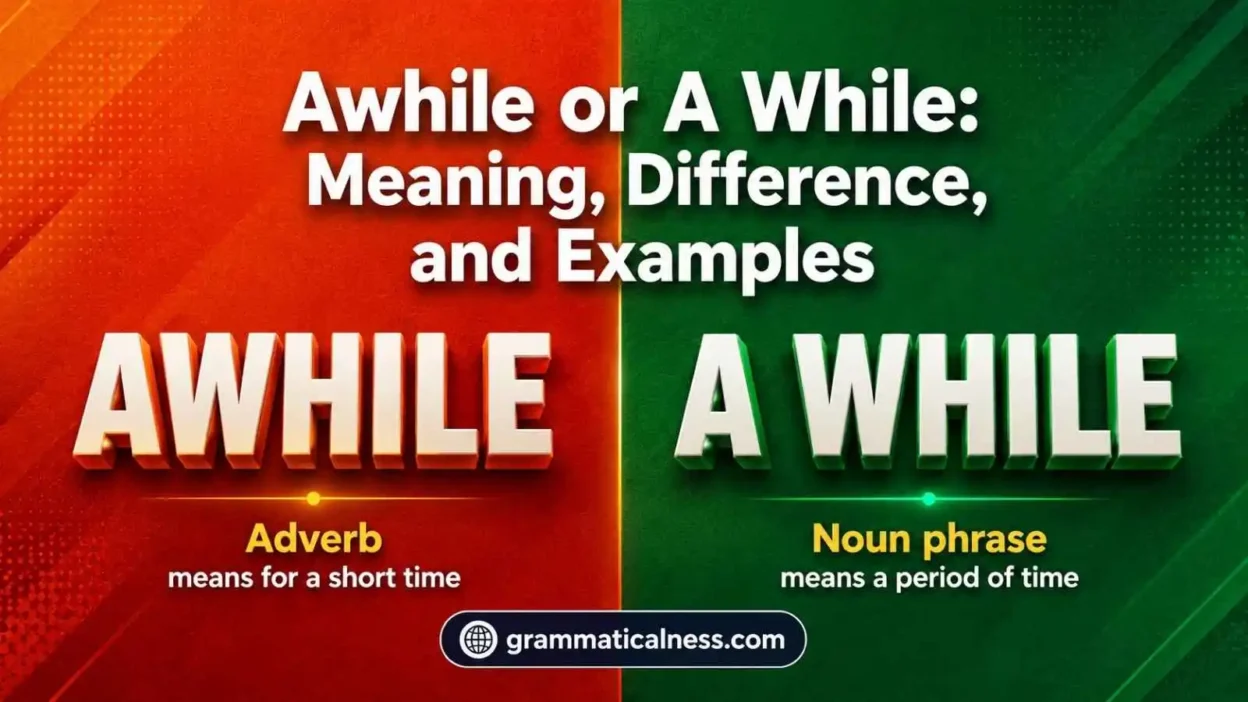
Both awhile and a while are correct, but they are not used the same way in careful writing.
The short answer is this: awhile is usually an adverb that means “for a short time” or “for a period of time.” A while is a noun phrase that means “a period of time.”
That one space changes the grammar.
Quick Answer
Use awhile when you mean for a while and the word is describing how long an action happens.
Example:
Please stay awhile after the meeting.
Use a while when you need a noun phrase, especially after words like for, in, after, quite, little, long, or ago.
Example:
Please stay for a while after the meeting.
A safe rule: if your sentence already has for, use a while, not awhile.
Why People Confuse Them
People confuse awhile and a while because they sound the same. In speech, you cannot hear the space.
They also both refer to time. That makes the difference feel small.
The real difference is grammar, not sound. Awhile already includes the idea of for. So wait awhile means wait for a while.
That is why wait for awhile sounds doubled in careful writing. It is like saying wait for for a while.
Avoid confusion like awhile vs a while and quickly master at least vs atleast for cleaner, more accurate writing.
Key Differences At A Glance
| Context | Best Choice | Why |
| After a verb with no preposition | awhile | It works as an adverb meaning “for a while.” |
| After “for” | a while | “For” needs a noun phrase after it. |
| After “in” or “after” | a while | These prepositions need a noun phrase. |
| Before “ago” or “back” | a while | The phrase refers to a period of time in the past. |
| With “quite,” “little,” or “long” | a while | These words modify the noun phrase. |
| In polished business writing | a while when unsure | It fits more sentence patterns safely. |
Meaning and Usage Difference
Awhile means for a while. It usually comes after a verb.
Examples:
We waited awhile before ordering.
She rested awhile after her run.
Stay awhile and talk.
In each sentence, awhile tells how long the action happened.
A while means a period of time. It works like a noun phrase.
Examples:
We waited for a while before ordering.
She rested for a while after her run.
It has been a while since we talked.
Here is the useful nuance: a while can also describe duration in sentences like Stay a while. That does not make it an adverb by form. It is still a noun phrase being used in a time-expression way.
Tone, Context, and Formality
In everyday US English, people often mix these forms, especially in texts and casual posts.
In careful writing, the distinction still matters.
Use awhile when the sentence is short and the meaning is clearly for a while.
Example:
Hang around awhile after class.
Use a while in more formal or edited writing when it follows a preposition or appears in common time phrases.
Examples:
The update may take a while.
I have not seen her in a while.
A while ago, we discussed this plan.
Pronunciation is simple: both are said like uh-WILE. The difference is written, not spoken.
Which One Should You Use?
Choose awhile when you can replace it with for a while without making the sentence awkward.
Correct:
I sat awhile by the window.
Test: I sat for a while by the window.
Correct:
The kids played awhile before dinner.
Test: The kids played for a while before dinner.
Choose a while when the sentence already has a preposition.
Correct:
I sat for a while by the window.
Correct:
The kids played for a while before dinner.
Also choose a while with common phrases like a while ago, a while back, in a while, and after a while.
When One Choice Sounds Wrong
For awhile is common in casual writing, but for a while is the safer choice in edited US English.
Wrong in careful writing:
I’ll be offline for awhile.
Better:
I’ll be offline for a while.
Awhile ago also sounds wrong in careful writing because ago needs a time noun phrase before it.
Wrong:
I saw that report awhile ago.
Correct:
I saw that report a while ago.
The same idea applies to a while back.
Correct:
We changed that policy a while back.
Common Mistakes (and Quick Fixes)
Mistake:
It has been awhile since our last call.
Better:
It has been a while since our last call.
Why: A while is the noun phrase after been in this time expression.
Mistake:
Come back in awhile.
Better:
Come back in a while.
Why: In is a preposition, so it needs the noun phrase a while.
Mistake:
Wait for awhile before sending the email.
Better:
Wait for a while before sending the email.
Also correct:
Wait awhile before sending the email.
Everyday Examples
Here are natural US-English examples you might actually write.
Email:
I’ll review the file in a while.
Text message:
I’m going to rest awhile, then call you.
Work chat:
This may take a while to load.
School:
We read awhile before lunch.
Travel:
The flight was delayed for a while.
Family:
Stay awhile. We just made coffee.
Errand:
I haven’t been to that store in a while.
Quick comparison:
| Feature | awhile | a while |
| Form | One word | Two words |
| Grammar role | Adverb | Noun phrase |
| Basic meaning | For a period of time | A period of time |
| Common use | Rest awhile | Rest for a while |
| Safe after prepositions | No | Yes |
Dictionary-Style Word Details
Verb
• awhile: Not commonly used as a verb in standard US English. Use it as an adverb: Wait awhile.
• a while: Not used as a verb. It is a noun phrase: It took a while.
Noun
• awhile: In careful standard usage, awhile is mainly an adverb, not a noun. Some casual uses place it after a preposition, but careful writing usually uses a while there.
• a while: A noun phrase made from a plus while. It means a period of time.
Example:
We talked for a while.
Synonyms
• awhile: Closest plain alternatives are briefly, for a bit, for a short time, and for some time. The best choice depends on the sentence.
• a while: Closest plain alternatives are a bit, a short time, some time, a period, or a little while.
Clear antonyms do not fit neatly because both terms name an amount of time, not a direct opposite idea. In some contexts, immediately or right away may contrast with waiting for a while, but they are not exact antonyms.
Example Sentences
• awhile:
Let’s sit awhile before we drive home.
The dog slept awhile after the walk.
She stayed awhile to help clean up.
• a while:
We waited for a while in the lobby.
It has been a while since I saw that movie.
After a while, the room got quiet.
Word History
• awhile: The one-word form developed from older wording meaning roughly “for a while.” It has long been used as an adverb of time.
• a while: The two-word form keeps the parts separate: a plus while, with while meaning a period of time.
The exact history is more detailed than most writers need for this choice. For modern US writing, the practical point is simple: awhile acts like for a while, while a while names a period of time.
Phrases Containing
• awhile:
stay awhile
wait awhile
rest awhile
linger awhile
read awhile
• a while:
for a while
in a while
after a while
a while ago
a while back
quite a while
a little while
a long while
once in a while
FAQs
Is “awhile” one word or two words?
Both forms exist, but they do different jobs. Awhile is one word and usually means for a while. A while is two words and means a period of time.
Is it “for awhile” or “for a while”?
Use for a while in careful writing.
Correct:
I waited for a while.
Also correct:
I waited awhile.
Avoid:
I waited for awhile.
Is it “a while ago” or “awhile ago”?
Use a while ago.
Correct:
I saw her a while ago.
Avoid in careful writing:
I saw her awhile ago.
Is “stay awhile” correct?
Yes. Stay awhile is correct because awhile means for a while.
Correct:
Stay awhile and have some coffee.
Also correct:
Stay for a while and have some coffee.
Is “it’s been awhile” correct?
In casual writing, you will see it often. In careful writing, it’s been a while is the better choice.
Better:
It’s been a while since we talked.
Can “a while” replace “awhile”?
Often, yes, but the sentence may need for.
Correct:
Rest awhile.
Correct:
Rest for a while.
Do not write:
Rest for awhile.
Which one should I use in formal writing?
Use a while when you are unsure. It fits more sentence patterns, especially after prepositions like for, in, after, and before words like ago or back.
What is the easiest way to remember the difference?
Use this test: if you can replace the word with for a while, then awhile may work.
Example:
Wait awhile.
Wait for a while.
But if the sentence already has for, use a while.
Conclusion
Awhile or a while comes down to grammar.
Use awhile when you mean for a while and it modifies an action:
Stay awhile.
Use a while when you mean a period of time, especially after a preposition:
Stay for a while.
When unsure, check for for, in, after, ago, back, quite, little, or long. Those words usually point to a while. That simple check will keep most sentences clear, natural, and correct.