
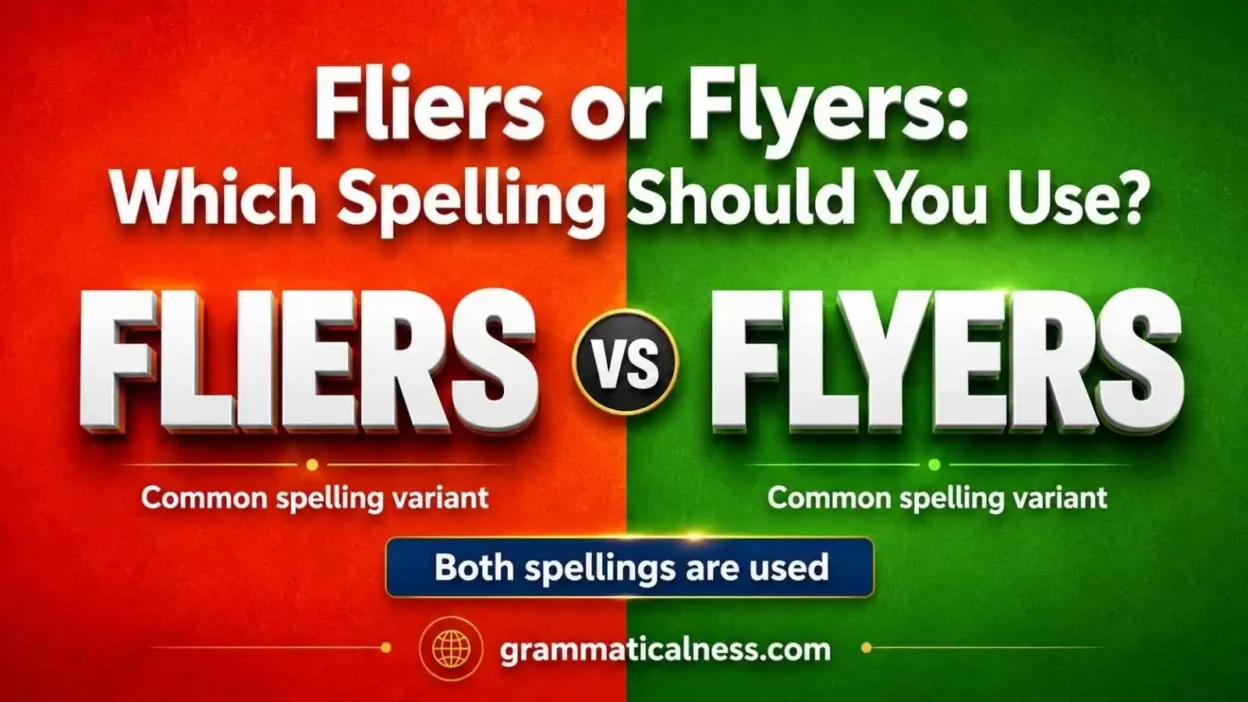
Should you write fliers or flyers? Both spellings are real, but they are not always the best choice in the same situation.
For most modern US writing, flyers is the safer choice when you mean printed ads, event handouts, school notices, or promotional sheets. Fliers is still accepted, especially for people or things that fly, and in the phrase take a flier, meaning to take a risk.
The best choice depends on what you mean and how formal or style-conscious your writing needs to be.
Quick Answer
Use flyers for printed advertisements, notices, and most everyday US writing.
Use fliers when you are talking about people, birds, insects, or objects that fly, especially if you want the more traditional form.
Use take a flier for the risk phrase.
In many cases, readers will understand either spelling. Still, flyers looks more natural for handouts in the US, while fliers can look more natural when the subject is flying.
Why People Confuse Them
People confuse fliers and flyers because they sound exactly the same. They also share many meanings.
Both can refer to people who fly. Both can refer to printed paper notices. Both are nouns. The difference is not a simple matter of one being correct and the other being wrong.
The real issue is expectation. US readers are used to seeing flyers for paper ads. They also recognize phrases like frequent flyer miles. But fliers still appears naturally when writers talk about passengers, pilots, birds, insects, or risk.
If you’re often confused between similar-looking words like fliers or flyers, you’ll also want to understand the difference in pliers or plyers to sharpen your grammar accuracy even further.
Key Differences At A Glance
Compact comparison:
- fliers: best for people or things that fly; also appears in “take a flier.”
- flyers: best for printed ads, handouts, notices, and most everyday US uses.
- Both: accepted plural nouns, but consistency matters.
- Safest default: use flyers, unless the sentence clearly points to flying or the risk phrase.
Meaning and Usage Difference
Fliers means people or things that fly. It can refer to airline passengers, pilots, birds, insects, or flying objects.
Example:
The tiny birds are fast fliers.
Flyers most often means printed sheets used to advertise or announce something.
Example:
The gym posted flyers for its summer classes.
The two forms overlap. You may see fliers for paper ads and flyers for air travelers. That does not make either form automatically wrong. But in modern US writing, flyers is the more natural choice for handouts.
For pronunciation, there is no useful difference. Both are said like “FLY-ers.”
Tone, Context, and Formality
Neither word is more formal by itself. The tone depends on the setting.
Flyers feels natural in marketing, school, business, and event writing. It is the spelling most US readers expect when the item is a paper or digital notice.
Fliers can sound a little more traditional when used for people or things that fly. It also fits cleanly in the phrase take a flier.
For careful writing, do not switch between the two spellings in the same piece unless you are using them for clearly different meanings.
Which One Should You Use?
| Context | Best Choice | Why |
| Printed event ads | flyers | This is the most natural US choice for handouts. |
| School notices | flyers | Readers expect this spelling for paper announcements. |
| Business promotions | flyers | It fits modern advertising and public notices. |
| Air travelers | fliers or flyers | Both are accepted, but “frequent flyer” is very common. |
| Birds or insects | fliers | It clearly points to things that fly. |
| Risk phrase | fliers | The usual phrase is “take a flier.” |
| General US writing | flyers | It is the safer default when no special meaning is needed. |
When One Choice Sounds Wrong
Fliers can sound odd when you are clearly talking about modern promotional material.
Less natural:
The restaurant printed 500 fliers for the grand opening.
Better:
The restaurant printed 500 flyers for the grand opening.
Flyers can sound less precise when you are describing birds, insects, or flying ability.
Less precise:
Bats are strong flyers.
Clearer:
Bats are strong fliers.
The sentence may still be understood either way. The goal is not to avoid a grammar error. The goal is to choose the spelling readers expect.
Common Mistakes (and Quick Fixes)
A common mistake is mixing both spellings for the same meaning.
Mixed:
We printed flyers yesterday and handed out fliers today.
Better:
We printed flyers yesterday and handed out flyers today.
Another mistake is using an apostrophe for a normal plural.
Wrong:
We need more flyer’s.
Correct:
We need more flyers.
Writers also sometimes use flyers in the risk phrase.
Less standard:
She took a flyer on the new business.
Better:
She took a flier on the new business.
Everyday Examples
The coffee shop left flyers on the community board.
Please bring the flyers to the PTA meeting.
The airline sent a deal to frequent flyers.
Some nervous fliers prefer aisle seats.
Dragonflies are skilled fliers.
The startup took a flier on a new delivery idea.
We saw flyers for the local food drive at the library.
The rescue group printed flyers for the missing dog.
Dictionary-Style Word Details
Verb
fliers: Not commonly used as a verb in standard US English. It is normally a plural noun.
flyers: Not commonly used as a verb in standard US English. It is normally a plural noun.
Use fly as the verb:
Birds fly south in winter.
Noun
fliers: A plural noun meaning people or things that fly. It may also refer to printed notices, but that use is less expected in everyday US writing.
Example:
The small planes are reliable fliers.
flyers: A plural noun meaning printed advertisements, notices, or handouts. It can also refer to people who fly, especially in familiar phrases about travel.
Example:
Volunteers passed out flyers downtown.
Synonyms
fliers: Closest plain alternatives include air travelers, passengers, pilots, aviators, or flying things, depending on the sentence. For the risk phrase, close alternatives include risks, gambles, or chances.
flyers: Closest plain alternatives include handouts, leaflets, circulars, pamphlets, or notices.
Clear antonyms do not fit the plural words well. For the phrase take a flier, the opposite idea is play it safe, but that is an opposite phrase, not a direct antonym of the word.
Example Sentences
fliers:
The airport opened a faster lane for frequent fliers.
Hawks are powerful fliers.
He took a flier on a small side business.
flyers:
The band printed flyers for Friday’s show.
We taped flyers near the front entrance.
The school sent flyers home with students.
Word History
fliers: This form comes from the idea of someone or something that flies. Over time, it also came to be used for risk in the phrase take a flier.
flyers: This form also comes from the word fly plus the ending that names a person or thing. In modern use, it became especially common for printed notices that are handed out or posted.
The history is shared and overlapping, so it is safer not to treat the two spellings as completely separate words.
Phrases Containing
fliers:
frequent fliers
nervous fliers
strong fliers
take a flier
flyers:
event flyers
school flyers
hand out flyers
frequent flyer miles
frequent flyer program
FAQs
Is it fliers or flyers?
Both fliers and flyers are correct spellings, but they are used differently in many modern US contexts. Use flyers for printed ads, notices, and handouts. Use fliers for people or things that fly, or in the phrase take a flier.
Which spelling is better for printed ads?
Flyers is the better choice for printed ads, event notices, school handouts, and promotional sheets.
Example:
The store printed flyers for its weekend sale.
Is “fliers” wrong?
No. Fliers is not wrong. It is a standard plural noun. It often works best when you mean people, birds, insects, or objects that fly.
Example:
Hummingbirds are amazing fliers.
Should I write “frequent fliers” or “frequent flyers”?
Both forms are possible, but frequent flyers is very common in travel programs and airline language.
Example:
Frequent flyers can earn miles on every trip.
What does “take a flier” mean?
Take a flier means to take a risk or try something uncertain.
Example:
She took a flier on a new business idea.
Can I use “fliers” for paper handouts?
Yes, but flyers is usually the more natural choice in modern US writing when you mean paper handouts or ads.
Less common:
We passed out fliers after school.
More natural:
We passed out flyers after school.
Are fliers and flyers pronounced differently?
No. Fliers and flyers are pronounced the same way: “FLY-ers.”
Which spelling should I use if I am not sure?
Use flyers if you mean printed notices or general everyday writing. Use fliers if the sentence is clearly about flying or the phrase take a flier.
Conclusion
For fliers or flyers, the clearest answer is this: use flyers for printed ads, notices, and most everyday US writing. Use fliers for people or things that fly when you want the traditional flying sense, and use take a flier for the risk phrase.
Both spellings are real. The difference is not about one being always correct and the other being always wrong. It is about choosing the form that fits the context. When in doubt, choose flyers for handouts and stay consistent.