
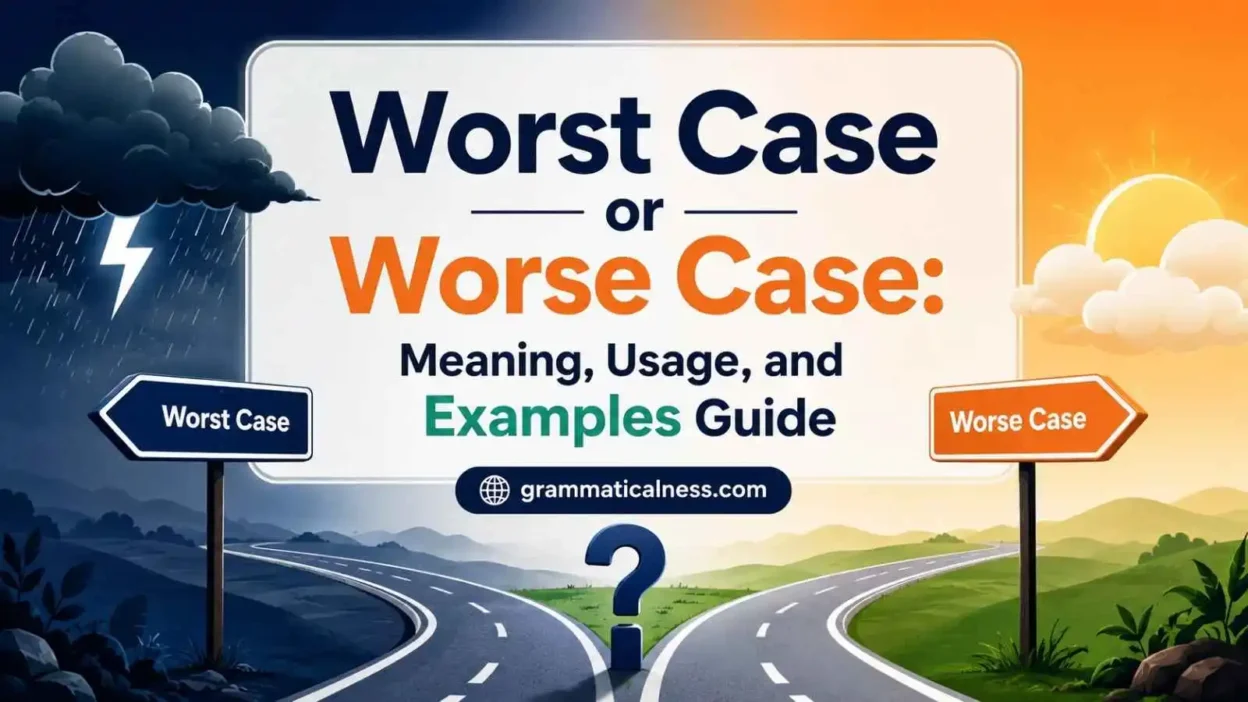
The usual correct phrase is worst case.
Use worst case when you mean the most negative possible result. For example: “In the worst case, we’ll reschedule the meeting.”
Worse case is usually wrong in that phrase. It can be correct only when you are comparing one case with another case. For example: “This is a worse case than the one we reviewed yesterday.”
So the choice is not just spelling. It is about meaning.
Quick Answer
Use worst case for the common expression.
Use worse case only when the sentence clearly compares two cases.
| Context | Best Choice | Why |
| Talking about the most negative possible result | worst case | “Worst” means the most bad or most unfavorable. |
| Saying what might happen if things go badly | worst case | The phrase points to the extreme outcome. |
| Using the phrase before “scenario” | worst-case | It works as a compound modifier before a noun. |
| Comparing one case to another case | worse case | “Worse” means more bad than another thing. |
| Writing a work email or report | worst case | It is the expected standard phrase. |
Why People Confuse Them
People confuse worst case and worse case because worse and worst look and sound close.
They also come from the same comparison pattern:
bad → worse → worst
Worse compares.
Worst points to the lowest or most negative point.
That small difference matters. A “worse case” needs another case to compare against. A “worst case” is already the most serious possible case.
In US speech, worse sounds like “wurss.” Worst sounds like “wurst,” with a final t sound. That final sound can be easy to miss in fast speech, which adds to the confusion.
Key Differences At A Glance
| Feature | worst case | worse case |
| Main meaning | The most unfavorable possible case | A case that is more unfavorable than another |
| Grammar role | Common noun phrase; also used in compound form before a noun | Comparative adjective plus noun |
| Common phrase? | Yes | No, except in direct comparison |
| Example | “Worst case, we refund the customer.” | “This is a worse case than last week’s.” |
| Best for formal writing | Yes | Only when the comparison is clear |
Meaning and Usage Difference
Worst case means the most unfavorable possible situation.
Use it when you are planning for risk, warning about a bad result, or naming the most serious likely outcome.
Examples:
“Worst case, we lose an hour.”
“In the worst case, the package arrives Friday.”
“We need a worst-case plan before launch.”
When worst case comes before another noun, it is often hyphenated:
“worst-case scenario”
“worst-case estimate”
“worst-case plan”
Worse case means a case that is more serious, more difficult, or more unfavorable than another case.
It needs a comparison:
“This is a worse case than the first one.”
“The second complaint was a worse case for the support team.”
Without that comparison, worse case usually sounds like an error.
Tone, Context, and Formality
Worst case works in casual, professional, academic, and business writing. It is the normal phrase readers expect.
You can use it in a text:
“Worst case, we grab dinner after the movie.”
You can also use it in a report:
“The worst-case outcome would require a full refund.”
Worse case sounds wrong in most everyday uses because readers expect worst case. It can sound natural only when the sentence clearly compares one case with another.
For careful writing, do not use worse case as a replacement for worst case.
Which One Should You Use?
Use worst case almost every time you are using the phrase as a set expression.
Choose worst case when you mean:
the most serious result
the most negative outcome
the least favorable situation
the backup plan if everything goes badly
Choose worse case only when you mean:
one case is worse than another case
A simple test helps:
If you can add “than another case,” use worse case.
“This is a worse case than the last one.”
If you mean “the most bad possible case,” use worst case.
“In the worst case, we start over.”
When One Choice Sounds Wrong
Worse case sounds wrong when there is no comparison.
Wrong: “In the worse case, we cancel the order.”
Right: “In the worst case, we cancel the order.”
Wrong: “Let’s prepare for a worse-case scenario.”
Right: “Let’s prepare for a worst-case scenario.”
Wrong: “Worst case than last time, we lose two days.”
Right: “Worse than last time, we lose two days.”
Right: “This is a worse case than last time.”
The key is simple: worse needs a comparison. Worst gives the extreme.
Common Mistakes (and Quick Fixes)
Mistake: “In a worse case, we lose the deposit.”
Fix: “In the worst case, we lose the deposit.”
Mistake: “That is the worse case scenario.”
Fix: “That is the worst-case scenario.”
Mistake: “We planned for the worse case.”
Fix: “We planned for the worst case.”
Mistake: “This case is worst than the last one.”
Fix: “This case is worse than the last one.”
Mistake: “The worse case is that the client leaves.”
Fix: “The worst case is that the client leaves.”
Everyday Examples
“Worst case, I’ll call a rideshare.”
“In the worst case, we move the appointment to Monday.”
“The worst-case scenario is that the flight gets delayed overnight.”
“We should budget for the worst case, not just the best case.”
“This is a worse case than the one we handled in March.”
“The first repair was simple, but the second was a worse case.”
“If sales drop again, the worst case is a hiring freeze.”
“Worst case, we order pizza instead of cooking.”
“The doctor said the test was not the worst case they had feared.”
“That file is messy, but the old backup is a worse case.”
Dictionary-Style Word Details
Verb
worst case: Not commonly used as a verb in standard US English. The phrase works as a noun phrase or as part of a compound modifier.
worse case: Not commonly used as a verb in standard US English. It works only as a comparative adjective plus noun when a case is being compared with another case.
Noun
worst case: Commonly used as a noun phrase. It means the most unfavorable possible case or outcome.
Example: “The worst case is that we miss the deadline.”
worse case: Can work as a noun phrase only in a direct comparison.
Example: “This is a worse case than the one we saw yesterday.”
Synonyms
worst case: Closest plain alternatives include “worst possible outcome,” “most unfavorable situation,” “least favorable case,” and “most serious result.”
worse case: Closest plain alternatives include “more serious case,” “more difficult case,” and “more unfavorable case.”
Clear antonyms are not always exact because the phrases depend on context. For worst case, a useful opposite is often “best case.” For worse case, a useful opposite is “better case” when two cases are being compared.
Example Sentences
worst case: “Worst case, we delay the trip by one day.”
worst case: “Our worst-case budget includes emergency repairs.”
worst case: “The worst-case scenario is a full system shutdown.”
worse case: “This is a worse case than the landlord described.”
worse case: “The second claim became a worse case after new damage was found.”
worse case: “Compared with last month’s issue, this is a worse case for the team.”
Word History
worst case: The phrase comes from the superlative idea of worst, meaning the most bad or most unfavorable. Major dictionaries treat worst-case as an established compound adjective.
worse case: This is not usually treated as a fixed expression. It is simply worse plus case, and it works only when the sentence compares one case with another.
No exact origin date is needed to use the phrase correctly.
Phrases Containing
worst case:
“worst-case scenario”
“worst-case estimate”
“worst-case plan”
“in the worst case”
“the worst case is”
worse case:
“a worse case than”
“the worse case of the two”
“a much worse case than expected”
Avoid “worse-case scenario” unless you are making a very specific comparison. In normal writing, the phrase readers expect is worst-case scenario.
Confused by tricky phrases? Learn the correct difference between “deep-seated” and “deep-seeded” to avoid another common writing mistake.
Conclusion
Choose worst case when you mean the most unfavorable possible outcome. That is the standard phrase in US English.
Use worse case only when you are comparing one case with another case.
The easiest way to remember it is this:
Worse compares.
Worst means the extreme.
So for the common phrase, write worst case.