

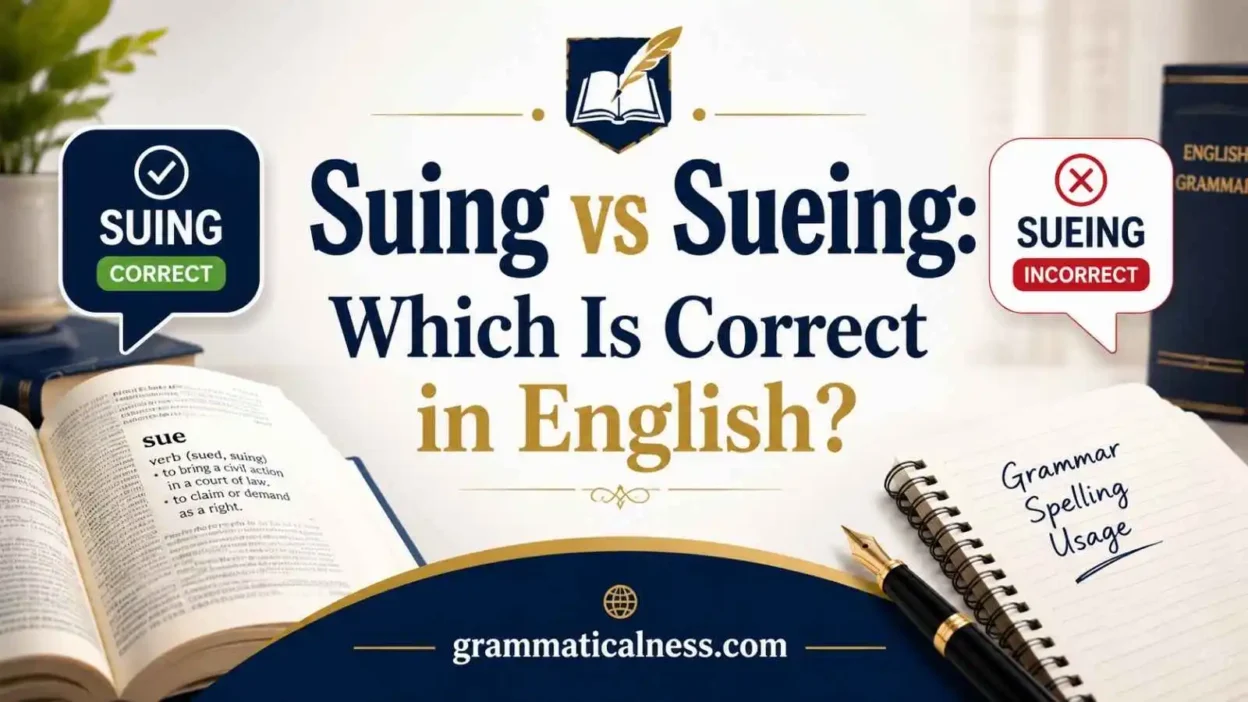
The terms “suing” and “sueing” are often confused, leading to a common debate about which one is the correct form to use. While they may appear to be interchangeable, only one is accepted as proper English. In this article, we’ll examine the correct spelling, usage, and why “suing” should always be your choice.
Quick Answer
The correct form is suing. The spelling sueing is incorrect and should be avoided in all contexts.
Why People Confuse Them
The confusion between “suing” and “sueing” arises because both terms are derived from the verb “to sue.” While “sueing” might appear to follow the pattern of other verbs in English that drop the final “e” before adding the “-ing” suffix, such as “cue” to “cueing,” the correct form in this case is “suing.” English speakers often mistakenly use “ie” in place of the more standard “ing” ending, but this is an error.
If you’re unsure whether it’s “laid out” or “layed out,” this quick grammar breakdown will help you avoid one of the most common English writing mistakes.
Key Differences At A Glance
| Context | Best Choice | Why |
| Correct spelling | suing | “Suing” is the proper, widely accepted spelling. |
| Common mistake | sueing | “Sueing” is incorrect and should be avoided. |
Meaning and Usage Difference
“Suing” refers to the act of taking legal action against someone, typically in a court of law. It’s the present participle form of the verb “sue,” which is used when referring to the process of initiating legal proceedings. On the other hand, “sueing” is an incorrect alternative, likely based on confusion with similar-sounding words.
Correct Usage:
- She is suing him for breach of contract.
- He is suing for damages after the accident.
By sticking to “suing,” your writing will align with proper English usage.
Tone, Context, and Formality
The word “suing” is appropriate in both formal and informal contexts. Whether you’re writing a legal document, a news article, or a personal message, “suing” is always the proper form. There are no circumstances where “sueing” would be acceptable.
Which One Should You Use?
Always opt for suing. It is the correct and standard form, and using it ensures clarity and accuracy in your writing.
When One Choice Sounds Wrong
The form sueing will sound awkward and incorrect in most contexts. In formal and professional writing, it is especially noticeable and should be avoided entirely. If you’re ever uncertain, just remember that “suing” is the only grammatically correct option.
Common Mistakes (and Quick Fixes)
Many writers accidentally use sueing when they mean suing. The fix is simple: always use “suing,” and you’ll avoid this common error.
Example Mistake:
- They are sueing for breach of contract.
Corrected:
- They are suing for breach of contract.
Everyday Examples
- She’s suing the company for wrongful termination.
- They are suing for damages following the accident.
- He was sued for negligence in the case.
Dictionary-Style Word Details
Verb
Suing is the present participle of the verb “sue,” which means to initiate legal action against someone.
Noun
The noun form is “suit,” referring to the legal proceedings or the case itself.
Synonyms
- Litigating
- Prosecuting
- Filing a claim
Example Sentences
- “She is suing her former employer for discrimination.”
- “They filed a suit for defamation.”
Word History
The verb “sue” comes from the Latin “sequor,” meaning “to follow.” It evolved through Old French into English, where it has retained its meaning related to legal action. The “-ing” ending is a standard verb conjugation rule in English.
Phrases Containing
- Sue for damages
- Sue for breach of contract
- Sue in a court of law
FAQs
Is “sueing” ever correct?
No, “sueing” is always incorrect. The correct spelling is “suing.”
Why do people often use “sueing” instead of “suing”?
The confusion likely stems from other English verbs that follow the “ie” pattern, like “cueing,” but “suing” is the proper form for this word.
Can I use “sueing” in informal writing?
Even in informal writing, it’s best to avoid “sueing.” “Suing” is the correct and widely accepted form.
Are there any other common mistakes with legal terms like “suing”?
Yes, some common mistakes include mixing up “suit” and “sue,” but the distinction is clear: “suit” refers to the legal case, and “sue” is the verb action.
Conclusion
In summary, the only correct spelling is suing. The alternative, sueing, is a frequent mistake that should be avoided. Always use “suing” when referring to the act of initiating legal action, and your writing will be grammatically correct.