
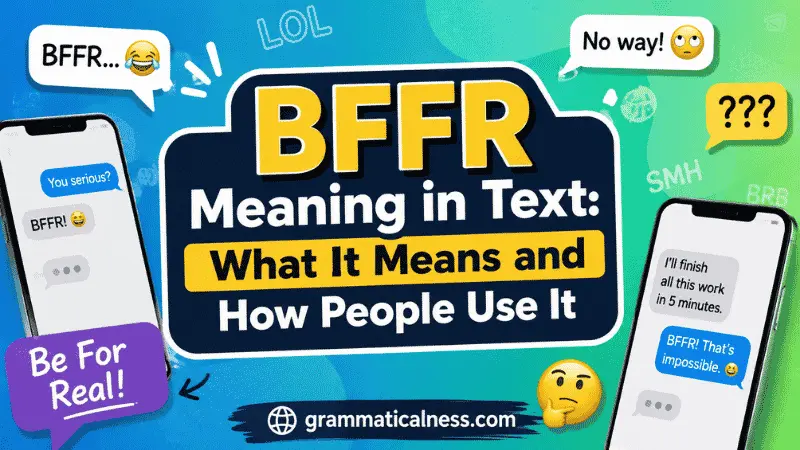
You may see BFFR in a text, group chat, TikTok comment, Instagram reply, or meme. It often appears when someone says something that sounds unrealistic, exaggerated, dishonest, or hard to believe. Because the letters hide a profane phrase, the message can feel stronger than a simple “seriously?”
BFFR is easy to misunderstand if you know BFF as “best friends forever.” The extra R changes the meaning completely. In modern online conversation, BFFR usually works as a quick reality check. It can sound funny between close friends, but it can also sound annoyed or confrontational.
This guide explains the BFFR meaning in text, its tone, common uses, related forms, and origin. You will also see realistic examples and learn when a softer phrase is a better choice.
Quick Answer
BFFR meaning in text is “be f***ing for real.” People use it to tell someone to be serious, honest, or realistic, often with disbelief or annoyance.
TL;DR
• BFFR means “be f***ing for real.”
• It usually expresses disbelief, skepticism, or frustration.
• Friends may use it playfully or sarcastically.
• The full phrase contains profanity.
• Avoid it in formal or professional communication.
• BFFR usually does not mean BFF.
What Does BFFR Mean in Text?
BFFR is an internet-slang initialism for “be f***ing for real.” In plain English, it means “be serious,” “get real,” or “you cannot seriously mean that.”
The expression usually functions like an imperative, which is a command or direct request. A person using BFFR is pushing someone else to face reality, stop exaggerating, or speak honestly.
For example:
• “You think you can finish that project in ten minutes? BFFR.”
• “He said he never saw the message—BFFR, his read receipt is on.”
• “They want $40 for that tiny sandwich? Seriously, BFFR.”
As a standalone reaction, “BFFR?” can mean “Are you serious right now?”
The letters are normally pronounced one by one: “bee-eff-eff-arr.” In speech, however, many people simply say the full phrase or use the cleaner “be for real.”
Uppercase and lowercase forms both appear online. “BFFR” may look stronger, while “bffr” often feels more casual. Capitalization does not change the basic meaning.
How People Use BFFR in Texts and Social Media
People use BFFR when a statement or situation seems ridiculous, unbelievable, unfair, or obviously unrealistic. The phrase often acts like a verbal eye-roll.
One common use is calling out exaggeration. If a friend claims they never check their phone, you might reply, “BFFR, you answer every notification in two seconds.”
Another use is challenging an excuse. Someone might write, “BFFR, you had all week to do it.” Here, the speaker sounds less surprised and more frustrated.
BFFR also appears in humorous reactions:
• “She said she only packed one outfit for vacation. BFFR.”
• “You called that a small snack? Seriously, BFFR 😂”
• “He thinks the dog did his homework—BFFR.”
Emojis can soften the message. A laughing face or skull emoji may signal teasing. Without those cues, the same letters can read as colder or more aggressive.
What Tone Does BFFR Have?
BFFR is strongly informal. Its tone ranges from playful disbelief to irritation, depending on the relationship and situation.
Among close friends, it may sound like teasing. “Girl, bffr 😂” can mean “Come on, you know that is not true.” The humor comes from shared context.
During an argument, the phrase can feel dismissive. It may imply that the other person is lying, being unreasonable, or refusing to accept facts.
The full wording also contains profanity. Even when the letters hide the swear word, many readers still understand what it represents. That makes BFFR risky in school assignments, formal emails, customer messages, or workplace conversations.
Softer alternatives include “be for real,” “seriously?”, “come on,” and “are you being serious?” These choices express similar disbelief without the same level of bluntness.
BFFR, BFR, BFF, and BSFR: What Changes?
Several short forms look similar, but they do not mean the same thing.
| Form | Common meaning | Typical tone |
| BFFR | Be f***ing for real | Strong disbelief or call-out |
| BFR | Be for real | Milder disbelief |
| BFF | Best friends forever | Friendly and affectionate |
| BSFR | Be so for real | Informal disbelief or emphasis |
BFR is the closest clean alternative. It removes the profane word while keeping the idea of telling someone to get serious.
BFF is unrelated in normal modern use. Confusing BFFR with BFF can completely change the tone of a message.
BSFR is another informal variation. Its wording may vary by community, so context still matters. If a message is unclear, the surrounding conversation is more reliable than guessing from the letters alone.
How to Reply When Someone Says BFFR
Your reply should match the reason the person used BFFR. If they are joking, a light answer usually works. If they are challenging you seriously, respond to the actual point.
For playful disbelief, you might say:
• “I am being serious 😂”
• “No, really, that happened.”
• “I knew you would say that.”
For a stronger challenge, you can answer more directly:
• “I am serious. Here is what happened.”
• “Fair point. I was exaggerating.”
• “I disagree, but I get why you think that.”
You do not need to use slang back. A clear response is often better when the tone feels tense.
Where BFFR Came From
BFFR is widely traced to African American Vernacular English, especially the long-standing phrase “for real” and the command “be for real.” The stronger wording adds profanity for emphasis.
The exact first use of the four-letter abbreviation is difficult to prove. Public records show versions of the phrase online before the early-2020s trend.
BFFR became much more visible across TikTok and Twitter in 2022. A widely shared soundbite helped spread the expression beyond communities where related phrasing was already familiar.
That history matters because internet slang often becomes mainstream after existing in particular speech communities first. It is more accurate to describe TikTok as helping popularize BFFR than as inventing the expression.
Mini Quiz
- What does BFFR usually mean in a text?
- Which is friendlier: BFF or BFFR?
- Is BFFR a good choice for a formal work email?
- What feeling does “BFFR?” often express?
Answer key:
- “Be f***ing for real.”
- BFF, meaning “best friends forever.”
- No. It is informal and contains implied profanity.
- Disbelief, skepticism, or frustration.
FAQs
On TikTok, BFFR usually means “be f***ing for real.” People use it in comments, captions, and reactions when something seems unbelievable or ridiculous.
It may be playful, sarcastic, or annoyed. The surrounding video, caption, and emojis help show the intended tone.
BFFR can sound rude because its full form contains profanity. It can also suggest that someone is lying, unrealistic, or not thinking clearly.
Among close friends, it may be playful. In arguments or with strangers, it can feel much harsher.
No in typical modern texting. BFF normally means “best friends forever,” while BFFR usually means “be f***ing for real.”
The extra letters create a completely different expression. Do not assume BFFR is a friendship term.
The standard modern expansion includes a profane word. Some people mentally soften it to “be freaking for real” or simply “be for real.”
Even so, readers may still understand the original wording. Use BFR or “be for real” when you want a cleaner option.
Yes. Friends often use BFFR as exaggerated disbelief or teasing, especially with laughing emojis.
Tone depends on context and relationship. The same message can sound hostile during a serious disagreement.
It is usually better to avoid BFFR in professional communication. The implied profanity and confrontational tone may sound disrespectful.
Use “seriously?”, “can you clarify?”, or “is that correct?” when you need a neutral alternative.
Conclusion
BFFR meaning in text is straightforward: it means “be f***ing for real.” The phrase usually signals disbelief, skepticism, frustration, or a demand for honesty.
Use it mainly in casual conversation where the other person understands your tone. When the setting is formal or the relationship is uncertain, “be for real” or “seriously?” is safer.