
Both traveled and travelled are real words. The difference is not meaning. The difference is spelling style.
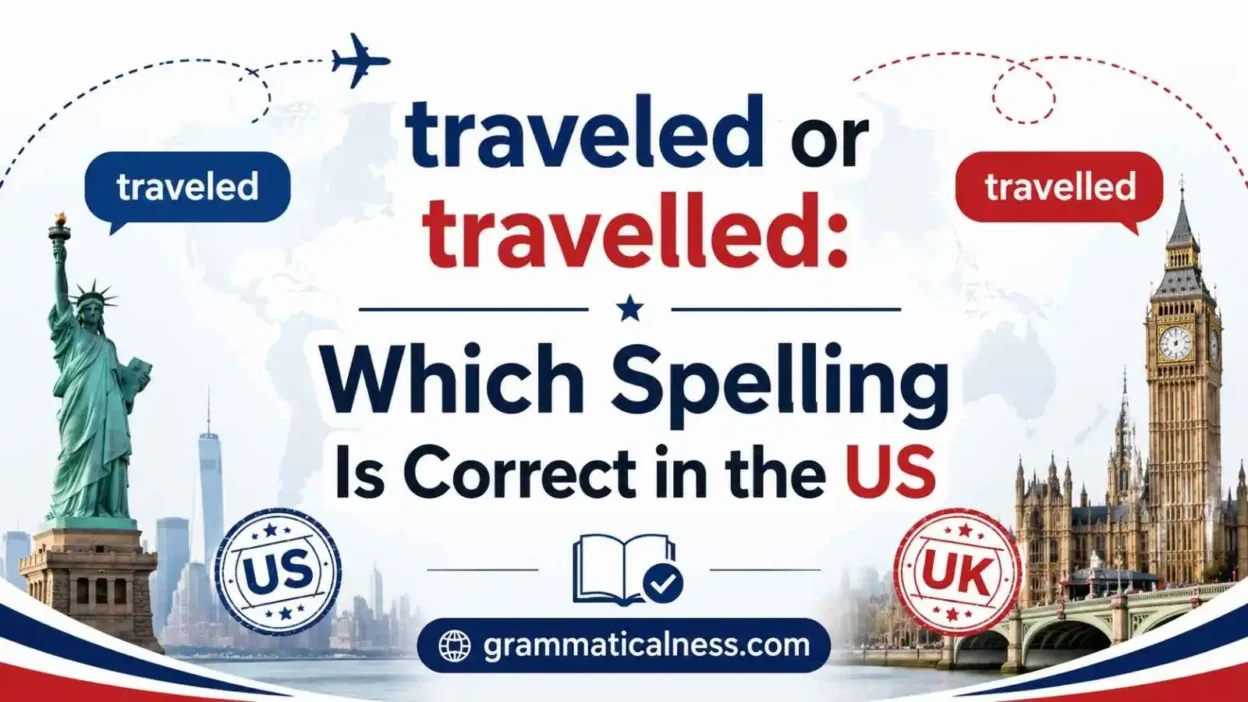
For a US audience, traveled is the standard choice. If you are writing for readers in the United States, use one l.
You may still see travelled in books, articles, and messages from outside the US. That does not make it wrong. It usually means the writer is following British-style spelling.
Quick Answer
Use traveled in American English.
Use travelled in British English and in many places that follow British-style spelling.
These words mean the same thing. They can both be the past tense and past participle of travel:
- I traveled to Denver last spring.
- She has travelled across Europe many times.
For most US writing, choose traveled.
Why People Confuse Them
People confuse traveled and travelled because both spellings appear in edited English.
The base word is travel. When English adds -ed, American spelling usually keeps one l in this word: traveled. British-style spelling usually doubles it: travelled.
The extra letter does not change the sound. Both are said like TRAV-uhld.
The confusion also grows because related words follow the same split: traveling/travelling and traveler/traveller.
Key Differences At A Glance
| Context | Best Choice | Why |
| US school paper | traveled | Standard American spelling |
| US business email | traveled | Looks natural to American readers |
| US news or web article | traveled | Fits common US style |
| British article or book | travelled | Fits British-style spelling |
| International document using US style | traveled | Match the chosen style |
| International document using British style | travelled | Match the chosen style |
| One document with both spellings | Choose one | Consistency matters |
Compact comparison:
- Traveled: one l, standard in American English.
- Travelled: two l’s, common in British-style English.
- Meaning: the same.
- Pronunciation: the same.
- Best US choice: traveled.
Meaning and Usage Difference
There is no meaning difference between traveled and travelled.
Both can mean that someone went from one place to another:
- We traveled from Chicago to Phoenix.
- They travelled from London to Rome.
Both can also work as past participles:
- I have traveled for work this month.
- She has travelled widely.
They can also appear as adjectives, usually in phrases such as well-traveled or less traveled:
- He is a well-traveled reporter.
- They chose the less travelled path.
For US readers, the first spelling will usually look normal. The second may look British or international.
Tone, Context, and Formality
The difference is not about formal vs casual writing. Traveled is not more casual, and travelled is not more formal.
The choice is about audience and spelling system.
In a US resume, school essay, client email, travel story, or company report, traveled is the safer spelling. It matches the spelling most American readers expect.
In British-style writing, travelled looks normal. A US reader will usually understand it, but it may stand out if the rest of the document uses American spelling.
Which One Should You Use?
Use traveled if you write for a US audience.
That includes:
- “I traveled to Boston for a meeting.”
- “Our team traveled to three states last month.”
- “She has traveled often for work.”
Use travelled only when you are writing in British-style English or quoting text that already uses that spelling.
The most important rule is consistency. Do not write traveled in one paragraph and travelled in the next unless you are quoting different sources or showing a comparison.
When One Choice Sounds Wrong
Neither word sounds different when spoken, so the issue is really how the spelling looks.
In American writing, travelled can look out of place:
- Less natural in the US: We travelled to Miami for the weekend.
- Better for US readers: We traveled to Miami for the weekend.
In British-style writing, the opposite is true:
- Less natural in British style: We traveled to Edinburgh.
- Better in British style: We travelled to Edinburgh.
The sentence meaning does not change. The spelling simply signals which style you are using.
Common Mistakes (and Quick Fixes)
Mistake 1: Thinking travelled is always wrong.
Fix: It is correct in British-style English. It is just not the standard US spelling.
Mistake 2: Mixing both spellings in one piece.
Fix: Pick one style and stay with it.
Mistake 3: Using travelled because it “looks more formal.”
Fix: Formal US writing still uses traveled.
Mistake 4: Changing the base word.
Fix: The base verb is still travel. Only the past form changes by style.
Mistake 5: Assuming the extra l changes pronunciation.
Fix: Both forms are pronounced the same way.
Everyday Examples
Here are natural US examples with traveled:
- I traveled to Austin for a family wedding.
- We traveled by train instead of flying.
- The nurse traveled between clinics all week.
- Marcus has traveled to every state except Alaska.
- The package traveled through three sorting centers.
- News of the decision traveled fast.
- They took the less traveled road to avoid traffic.
- A well-traveled backpack can still last for years.
Here are British-style examples with travelled:
- She travelled to Manchester for the interview.
- They have travelled across Scotland by car.
- The group chose a less travelled route.
Dictionary-Style Word Details
Verb
traveled: The American English past tense and past participle of travel.
Example: “I traveled last week.” / “I have traveled often.”
travelled: The British-style past tense and past participle of travel.
Example: “She travelled last week.” / “She has travelled often.”
Noun
traveled: Not commonly used as a noun in standard US English. Use travel, trip, or journey instead.
Example: “Business travel can be tiring.”
travelled: Not commonly used as a noun in standard English. Use travel, trip, or journey instead.
Example: “Her travels took her across Asia.”
Synonyms
traveled: Closest plain alternatives include journeyed, went, toured, crossed, and visited, depending on the sentence.
Example: “We traveled across Texas” can become “We crossed Texas.”
travelled: The same closest plain alternatives apply: journeyed, went, toured, crossed, and visited.
Clear antonyms do not always fit because traveled/travelled describe movement or experience. In some sentences, the opposite idea may be stayed, remained, or settled, but those are context-based, not exact opposites.
Example Sentences
traveled:
- We traveled to Seattle for a conference.
- She has traveled more since starting her new job.
- The story traveled quickly through the office.
travelled:
- They travelled to Dublin in the spring.
- He has travelled widely for research.
- The less travelled path was quieter.
Word History
traveled: The base word travel has been in English for a long time and is connected with older forms that meant labor, effort, or journeying. The one-l spelling became the expected American form for this past-tense spelling.
travelled: The two-l spelling stayed common in British-style English. The history is best treated as a spelling-style split, not as a meaning split.
Phrases Containing
traveled:
- well-traveled
- widely traveled
- less traveled
- much-traveled
- heavily traveled road
travelled:
- well-travelled
- widely travelled
- less travelled
- much-travelled
- heavily travelled road
FAQs
Is “traveled” or “travelled” correct?
Both are correct. Traveled is the standard spelling in American English. Travelled is common in British-style English.
Which spelling should I use in the US?
Use traveled for US readers. It looks natural in American school papers, emails, articles, resumes, and business writing.
Is “travelled” wrong in American English?
It is not wrong as a word, but it can look out of place in American writing. For standard US style, traveled is the better choice.
Do “traveled” and “travelled” mean the same thing?
Yes. They have the same meaning. The only real difference is spelling style.
Are “traveled” and “travelled” pronounced differently?
No. Both are pronounced the same way: TRAV-uhld.
Can I use both spellings in one article?
Avoid mixing them. Use traveled throughout an American English article. Use travelled throughout a British-style article.
Is “well-traveled” or “well-travelled” correct?
Both are correct. Use well-traveled in American English and well-travelled in British-style English.
Why does “travelled” have two l’s?
The double-l spelling is common in British-style English. American English usually uses one l in traveled, traveling, and traveler.
What is the past tense of “travel” in American English?
The American English past tense is traveled.
Example:
“I traveled to New York last month.”
What is the past participle of “travel” in American English?
The American English past participle is also traveled.
Example:
“She has traveled for work many times.”
Conclusion
For American English, traveled is the best choice.
Travelled is also correct, but it belongs mainly to British-style spelling. The two words mean the same thing, work the same way in grammar, and sound the same when spoken.
Use traveled for US readers, use travelled for British-style writing, and keep one spelling style throughout your document.